|
|
FEAR |
| REVIEWS | STORY TIME | FANBOY | HORROR MOVIES | CONVENTIONS | SCIENCE MOMENT | HORRIBLE NEWS |
|
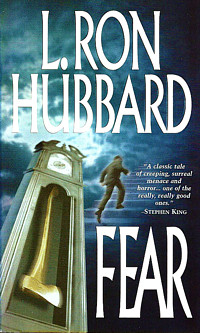
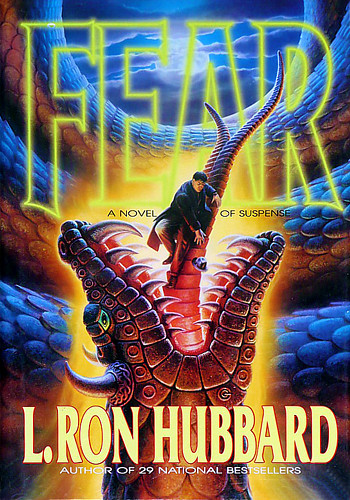
L. Ron Hubbard was a world traveler and many other things before he decided to be a writer. When he finally made that decision to become a man of words, he wrote FINAL BLACKOUT, what Robert Heinlein called: "..as perfect a piece of Science Fiction as has ever been written." When Ron decided to write Fantasy he wrote SLAVES OF SLEEP, which Anne McCaffrey called "A master of adventure." To be brief, every novel he wrote in every genre he chose to write in was classed by the grand masters of the form of that period as the absolute best of its kind. Heady stuff! No less than Robert Bloch called FEAR, L. Ron Hubbard's "finest work". Consider the context in which Rob made that statement. Ray Bradbury, who in my humble opinion has bridged the gap of being the greatest Science Fiction and Horror writer ever called FEAR "A true scare". Stephen King called FEAR "A classic tale of creeping, surreal menace and horror." At the 2001 Comic Convention in San Diego, I came across a booth put up by the Hubbardites / Scientologists. I was stopped. The guy who stopped me introduced himself and I did the same.
"A Horror site?" he said. "Have you ever heard of FEAR?" "Of course," I answered. "I'm a Horror fan after all." "Would you review this book if I gave it to you?" "Natch," I said. And here we are. Of course, as any visitor to this site can attest, not free books or even friendship means a good review if we think the book sucks. So FEAR, originally published in 1940, was praised by the hoary old guard of Horror. Big yip! What does that mean to me and this current generation of Horror fans? This freaking book is pretty damn wild! FEAR is the story of one James Lowry. James comes from a well respected, socially well placed family of stodgy old professors who have taught, from one generation to the next, at the University of Atworthy. Though written in a modern vein for its time, FEAR can be read as a period piece and not lose anything in the translation. In this pre-World War II novel, the college students walk down the sidewalk and give due respect to their professors as they pass. Everyone knows each other by name. This is the quiet, well-mannered life at ease that Television episodes of The Twilight Zone used to paint. In fact, reading FEAR makes me think that surely, this was the inspiration for Rod Serling's creepy brainchild. All the trappings of that show are here. The average white male comfortably living in his social niche, each day just like the other, then everything goes wrong. Not all at once of course. It's the little things that start wrecking the scenery: a touch of non-deadly malaria at first, grows into the bigger issue of a dressing down and losing his job. The next thing Jim Lowry knows is that his hat is missing and there is four hours out of his day for which he has no recollection and no way of accounting for: every avenue of investigation leads to a dead end. His life long friend Tommy Williams can't help him. The man wants to, but has no more idea about those missing four hours than Jim. During that period, Jim's beloved wife, Mary, went out looking for him. She returns home to find a shaken Jim, terrified by the loss of time. How could the day just go from quarter after three to a quarter after seven? And where is his hat? It seems such a stupid thing to worry about: a hat. Yet the hat becomes the catalyst. It wasn't just a period of time that was lost. Time is an arbitrary thing of relative substance. But he lost his hat during that period as well, and a hat is a material thing. If he can find his hat, then maybe he can remember how he lost it, and so gain back, at least the memory of, those missing hours. It's not long before Jim is haunted by the call of his wife shouting "Jim! Oh my God! Jim!" Yet when he finds his Mary, she tells him she said no such thing. Then dreams become reality or maybe reality is a dream, but through a surreal and creepy set of circumstances, Jim finds himself near the bottom of a pit, standing before a door and speaking to a half-witted, cackling crone. Jim speaks to her in the respectful vernacular of the day by calling her Mother. The old woman is a stranger to Jim - not his real mother. That said, she knows his problem and she tells him: "Don't try to find your hat." "Why not Mother?" "Because if you find your hat you'll find your four hours, and if you find your four hours then you will die!" From here on in the story spirals down into a well of madness for Jim. Intrusions of ALICE THROUGH THE LOOKING GLASS enter this tale without ever being credited (just as well. I don't need to be patronized or given a literary nod and wink. I know what I'm reading). James is pursued by angels and demons and other forms of which he has no idea. Everything he depended on and trusted is unraveling in the most terrifying of ways. If you are the kind of person I am, then books with tons of praise and accolades just make you that more suspicious about the story within. Just what do all those blurbs mean? Are they trying to buy your opinion with your need for conformity? Yet FEAR doesn't just stand on its own merits: it soars. This book, over 60 years old, is not only a classic, but is the inspiration behind the very best in stories and movies today. Those who have watched films like THE SIXTH SENSE and THE OTHERS will find this old tome to be the likely genesis for both. Yet FEAR remains unsurpassed with a tale and an ending both hallucinatory and - at the same time - lucid. I've read many a story with an unexpected ending. Those are always nice. But when you reach the final page of FEAR it is not only unexpected, but a surprise. The unexpected isn't always a surprise. A surprise stops you dead in your tracks. L. Ron relied on no tropes for FEAR. No monsters of any kind for which, novel after novel, we have grown accustomed. When you read this story, you may find yourself, from time to time, in familiar territory. Remember where that familiar knowledge comes from, and be reminded that this book is most likely the ancestor of those who came after, wrote after, because they were inspired after reading this book. L. Ron eventually decided to be a Science Fiction writer. Too bad. None of his SF work came near to the power of FINAL BLACKOUT. There is no way of knowing for sure, of course, but L. Ron could have really made his mark as a Horror writer, instead of all else. FEAR is the real thing. It is the definition of Horror and what we look for as fans. There is a bonus tale included in the latest version of FEAR. I don't recommend reading it right away, or anything else for that matter. All will seem, for awhile anyway, pale and drawn after you have read FEAR. 5 BookWyrms.
This review
copyright 2001 E.C.McMullen Jr. |
|
||||||||||||||||||||
| Feo Amante's Horror Home Page, Feo Amante's Horror Thriller, and feoamante.com are owned and copyright 1997 - 2014 by E.C.McMullen Jr. FAIR USE - PRIVACY POLICY - OWNERSHIP - CONTACT All images and text belong to E.C.McMullen Jr. unless otherwise noted. All fiction stories belong to their individual authors. |
 |