 |
 |
JACK |
| JACK KETCHUM | FANBOY | MOVIES | CONVENTIONS | SCIENCE MOMENT | HORRIBLE NEWS |
|
Monica J. O'Rourke interviews
JK: Not personally, thank god. I think I've excised most of those people from my immediate family, so to speak. And you can't be in New York and not see bullies. Okay, here's a good bully story. I'm in Greece during 9/11. I think that the woman I've lived with for many, many years now is dead. I don't find out until about four and a half hours later. I'm watching the second plane hit the second tower, which is where she's working. I see this live, and I'm sitting in a café because I've been alerted to this by people I was traveling with. So I'm sitting in this café, I see it hit, and I start to cry, because I'm sure she's dead. A young woman standing in front of me turns around and smiles at me. She doesn't like Americans, she's pissed off at Americans for some reason, and there I am weeping. And I consider her a bully. For that moment in her life at least, she was evil. MO: That was a very sadistic thing for her to do. JK: A very sadistic, evil thing to do. And so, yeah, they're still around us. They're all around us. They mask themselves, or they don't, we're probably lucky if they reveal themselves to us. Then we can deal with them. But yeah, of course they're out there. MO: Do you still scare yourself? JK: Oh yeah. Do you mean do I scare myself with my own internal demons? I try to scare myself on the page whenever I write. That's my job. If I'm writing a love scene, I'm supposed to make you feel love, if I'm writing terror, I'm supposed to make you feel terror. If I want to write about a pussy cat, I'm supposed to make you see the pussy cat. I haven't gone out of my way to hurt anybody in over forty years, so I consider that part of my particular demon is quashed. MO: How can you say that? That in forty years you've never—
MO: You never wanted to? JK: Not really. At some point I realized that that would diminish me, make me less human. MO: But in forty years no one's angered you? JK: Oh of course. But I don't take it out on people. That would make me less than what I want to be. What I want to be is somebody who lets those assholes roll off his back, and climbs up on their backs and says "Hi down there. Eat shit and die. I can forget about you. You don't mean anything to me anymore." So my sense of revenge or anger is gone, except for the government (laughs). MO: A lot of people who hurt or belittle other people usually do it because of low self-esteem, to make themselves feel better. So do you think your self-esteem is so solid, or that you're so confident in yourself, that you don't feel the need to hurt or belittle anyone else?JK: I think you're right about self-esteem being a large part of the problem. I think it's a large part of the problem with international relations. I'm pretty okay in my own shoes now. MO: Yeah but—forty years? You're talking about a very young man who made this decision. You were what? twenty? Not even twenty. JK: Okay, I'm fifty-nine, so that was probably about right. I was nineteen or twenty when that thought struck me like a sort of little strange lightening bolt: it's better if you don't do this, it's better if you don’t try to do this. And I can hurt people, as I think everyone can. I wrote in the first chapter of Joyride about a cop driving down a highway, and all these bugs are smashing against his window. You can't live in the world without hurting things. It's not possible. But you don't have to try. And I gave up trying at that point. And I never went back. MO: Do you consider yourself a pacifist? JK: Yes. Oh yes. MO: So you're like Gandhi? (laughs) JK: No. No, no, no. I'm too angry to be Gandhi. MO: You're angry but don't take it out on other people. JK: What I do—my anger goes mostly into my books. And I suppose the people I live with (laughs). Every now and then. MO: That's what I was wondering. How can you live with somebody and not get angry?
JK: Anger in a relationship is an expression of dissatisfaction with the relationship at that particular time. You're supposed to yell at one another in relationships I think, otherwise it's a conspiracy of silence. The other person is supposed to know when they've transgressed. That's with friends as well. You're supposed to call somebody when they've done something wrong. That doesn't mean you're supposed to hold it against them for the rest of their fucking lives. You're supposed to simply say it, get it done, and get it on. And I want people in my life to do that to me too. I want them to call me on my bullshit. MO: What other Ketchum novels have been optioned? JK: Off Season. The Girl Next Door. Lucky (McKee) has got Red, and also my film script for The Passenger. MO: Is The Passenger long enough to be a full length movie? JK: I wrote The Passenger initially as a screenplay. And then I transferred it into a novella. And then when I'd read what I had done with the novella, I said my god . . . there were a lot of gaping holes in the screenplay. Because prose is different from cinema. You can leave stuff out in cinema, skip over stuff, but you can't really in prose. I caught a lot of mistakes. I corrected the mistakes and then went back and rewrote The Passenger (script). I'd shopped that around for quite some time and maybe the mistakes were why it never got bought, because as soon as I corrected them, Lucky picked it up. So I think it's a viable movie now. MO: You mentioned The Girl Next Door? JK: Yeah. That's got a very good script by Phil Nutman and his partner Dan Farrands, which they wrote some years ago. And I was so taken with the script, I said, "I couldn't have done a better script of this." It's so faithful and so smart. Also, Ladies’ Night, though it's not really optioned now because (director) Stuart Gordon has let the option sort of drop. But he calls me every now and then says, "We'll still talk about Ladies’ Night." And I have a co-writing credit on that. I wrote a script based on that earlier on and he took a lot of my stuff. MO: What, for you, is “the perfect story”?
JK: “The perfect story?” The perfect storm? (laughs) Well I guess the perfect story is almost like the perfect storm, isn't it? I mean when things collide. It sort of is. It's often when I find the way to write a story, I've got something on my bulletin board, and something else on my bulletin board, and something else on my bulletin board, and they all sort of collide in my brain. So in a way it is like a perfect storm. MO: It's a mixture of everything that finally comes together? JK: Yeah. I can finally find my way to putting this to that and the other. A lot of things that I jot down are real events. And I don’t want to make a story just about one real event. I want them to coalesce somehow, into other real events. So for instance, when I did The Lost, what really kick started The Lost was that (writer) Chris Golden had sent me a clip saying that this is the perfect Ketchum story. About this guy who had shot two women in the woods because he thought they were lesbians. That gave me the kick into the Schmidt story. And that made the novel. I had the first scene.
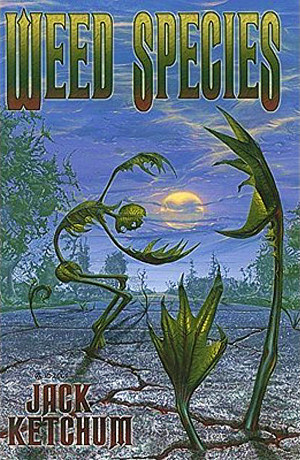
JK: No, he had no idea I was even thinking about the Schmidt story. Totally separate events. That happens to me a great deal. MO: Sort of like Weed Species, which isn’t out yet. (To be published later this year by Cemetery Dance) Based on actual events.JK: Weed Species is a small novella. It's been illustrated by Alan M. Clark. He’s done the cover, and Glen Chadbourne is doing the interiors. They’re quite nice. Almost allegory, because people aren’t going to know what the hell this thing is until they open the book. MO: I was really quite surprised by it when I read it. JK: It's the most vicious thing I think I've ever done. MO: It is brutal. JK: And I think the reason it is so hard is, in this case I almost don't give you any sympathy for the characters. They’re weeds. You need to pluck them. (laughs) MO: When you and I discussed this story, you seemed almost put off by your use of graphic language in this story. JK: It seemed to bother me? No, I wanted to bother you. MO: Well it did. But I got the impression you were also put off by it. JK: Well yes, of course I'm put off by it. Again, if I don't make myself feel something, I’m not going to make you feel something. So in this case, I wanted to make you feel repulsed. So I had to repulse myself. So I used those kinds of words, and I used that kind of dialog, where for example at one point he's telling this rape victim to talk back to him like he's Daddy, like he's the best fuck she's ever had and all that shit. They do that. Most of this dialog was taken straight out of transcripts. And that's what they say. And yes, it turns me very, very off, so to turn you off, I used it. MO: Anything else you'd like to add about the perfect story? JK: Okay. About the perfect story—it's got to be about people. It can’t just be about story. It’s got to reach you on a very gut, human level. Or I don’t want to write it. It’s got to make you think about yourself . . . bleed a little. MO: Do you prefer to write novels or short stories? Which do you find easier? E.C. McMullen Jr. is a participant in the Amazon Services LLC Associates Program, an affiliate advertising program designed to provide a means for sites to earn advertising fees by advertising and linking to amazon.com. |
|
|||||||||||||||||||||||||||||||||||||||||||||||||




 MO
MO

 Feo Amante's Horror Home Page, Feo Amante's Horror Thriller, and feoamante.com are owned and Feo Amante's Horror Home Page, Feo Amante's Horror Thriller, and feoamante.com are owned and Copyright 1997 - 2018 by E.C.McMullen Jr. FAIR USE - PRIVACY POLICY - OWNERSHIP - CONTACT All images and text belong to E.C.McMullen Jr. unless otherwise noted. All fiction stories belong to their individual authors. |