 |
 |
Review by Pat LeCat |
 THE
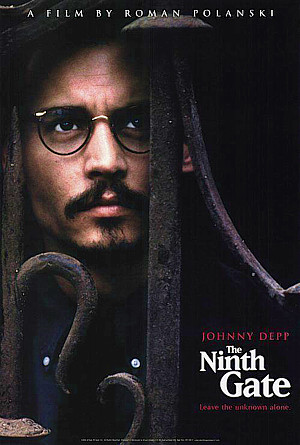
NINTH GATE aka La Neuvieme Porte - 1999 THE
NINTH GATE aka La Neuvieme Porte - 1999USA Release: March 10, 2000 BAC Films / Araba Films / Artisan Entertainment [US] Rating: Belgium: KT / France: U / Spain: 13 / - USA: R |
||
Whether dealing with Jewish vampires or geriatric devil worshippers, or just plain neighbors from hell, Polanski has shown in the past how adept he is at mixing humor and horror - to the point that you can't distinguish whether you're horrified by the humor or amused by the horror.
Witness Ruth Gordon smoothing her precious floorboard after Mia Farrow drops the knife in the climactic scene of ROSEMARY'S BABY. Amidst all the madness and mayhem life does go on, Polanski seems to be saying, down to its more mundane aspects: they might be monsters, but they still use toilet paper. And underneath the almost camp humor is the disturbing assumption that of course, all of this could be true.
Hitchcock already hinted that horror was like black comedy. Both genres treat dysfunctional behaviors as the norm, while the "normal" acting character is the odd man out. Provided such normalcy even exists. Polanski takes it one step further: there is no normal behavior; only different levels of social dysfunctionment: from nosy neighbors to conspirators, from damsels in distress to women on the verge of paranoia. Though each director has a distinct voice, their characters could easily switch from one's filmography to the other's: a mama's boy who'd rather stuff birds than women (PSYCHO), a cross-dressing impotent living in isolation (CUL DE SAC), a woman whose neurosis drives her to criminal acts in the workplace (MARNIE/REPULSION) . . . the list could go on.
But despite a murder scene that looks very much like an homage to FRENZY, there are few things worthy of Hitchcock in THE NINTH GATE. The black bordering-on-camp humor is more than ever present, only this time it seems to be poking fun at the picture itself. Obviously Polanski doesn't take the story seriously even though we are meant to. Which is not only an insult to the audience's intelligence but makes for an ultimately disappointing movie.
Johnny Depp (A NIGHTMARE ON ELM STREET, EDWARD SCISSORHANDS, THE ASTRONAUT'S WIFE, SLEEPY HOLLOW, PIRATES OF THE CARIBBEAN [all], THE CORPSE BRIDE, SWEENEY TODD: THE DEMON BARBER OF FLEET STREET) is Dean Corso, a cynical, jaded, world-weary book dealer - in short a literary Private Dick. Boris Balkan, played with creepy relish by Frank Langella (DRACULA, BRAIN SCAN) has a library devoted to demonology, which most prized book, "The Nine Gates", has such a bad reputation its printer was burned at the stake along with his production (this was a few centuries before Madonna's “Sex.”) Only three copies of the book still exist, but only one of them is authentic. Balkan wants Corso to track down the two remaining copies, and find out which is the authentic one. Balkan, who is rich and eccentric (they have to be rich or Private Dicks wouldn't bother and they better be eccentric or the audience wouldn't bother either), promises enough money to hint that Corso's scruples should be set aside, just as Balkan's are.
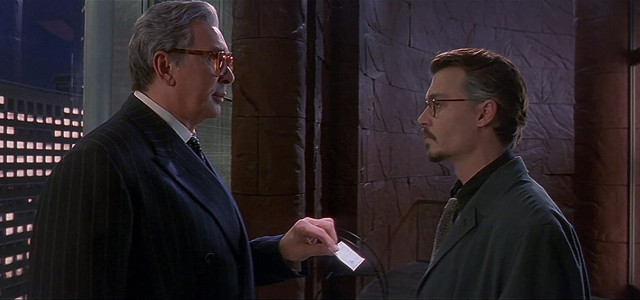
It is understood early on that whatever secret the book holds is contained in its nine engravings. Lots of people seem to be interested in cracking it, such as the widow of the book's previous owner, who committed suicide in the opening scene: as Liana Telfer, actress Lena Olin (DARKNESS) does everything short of going on all fours and growling to convince us she's one dangerous dame people better be on the good side of, wherever that may be. Corso is either unimpressed, too macho to give in (though he doesn’t turn down an early bit of nooky) or just plain stupid (a hypothesis the rest of the movie would tend to confirm) His refusal ensures trouble for everyone, starting with colleague and friend Bernie (James Russo: TRAUMA) who meets an end similar to one of the engravings.
From Spain to France, Corso has to bluff and lie his way to the other books, as the body count gets higher, villains and police chase him, events start mirroring the engravings, and a mysterious girl (Emmanuelle Seigner: FRANTIC) casually pops in to lead him in/out of trouble, scratching more of his macho status in the process.
The problem is that aside from getting repeatedly bumped in the head and rescued with tiresome regularity by Emmanuelle Seigner, Johnny Depp's character doesn't do much to get the story moving, except what other people want him to. Not only that, we are so much more privy to what's going on than poor Corso, like who gets to fly in the air behind his back, that we can't help feeling a trifle superior to the hero, always a handicap for character identification. I mean, would you trust someone whose eyes keep turning from brown to green in the middle of conversation? Personally I would only if the conversation were limited to « walk/don't walk » and even then I'd check left and right before crossing the street.
But who am I to wisecrack? Shouldn't I know that when the hero hasn't got a clue, I the spectator should feel as helpless as he does and therefore *Scared*? Well, it worked for ANGEL HEART (whose premise, incidentally, is very similar if you replace the book by a missing crooner) But then the Alan Parker thriller of the occult boasted a genuinely terrifying atmosphere and a terrific ending. In order to suspend disbelief, you need to feel the director is willing to suspend his own, or pretend to, if only out of courtesy for the audience. At the very least you would expect him, in a scene that finally reveals the hidden meaning in the engravings, to show the goddamn things!
As parody takes over the story, you get the feeling that Polanski is not so much making a movie than taking an amused look back at his career. When he has a whole coven literally fleeing in terror from someone saying “boo!”, you can't help wishing he had done instead the sequel to ROSEMARY'S BABY that was published last year. In SON OF ROSEMARY, author Ira Levin was also up to his old tricks to the point of self-parody, which was enjoyable in its way, and which THE NINTH GATE does too but to disappointing results. Those who felt cheated by the final twist in SON OF ROSEMARY should feel grateful that there was one (and a pretty good one according to this reviewer, even if it infuriated many) Here, the movie just peters out as if it had ran out of thrills and couldn't come up with anything to top them.
For the ending of THE NINTH GATE is really where you decide that you just spent two entertaining but pointless hours.
Believe me,
I'm all for an ending that leaves something to the imagination, as in Polanski's own ROSEMARY'S BABY. So yes, an ambiguous ending can be elegant, tasteful AND powerful. Except that THE NINTH GATE is not that kind of movie. It's camp, trashy and over the top, even in the parts where it plays at subtlety. Furthermore, it is meant to be that way. For two hours, you get a thrill ride in a funhouse, with teases and hints at bigger attractions to come. When the big pay-off turns out that basic, you can't help feeling slightly insulted that the filmmaker assumed you'd need 132 minutes of screen time to figure it out. Especially when you've been promised a much more sophisticated outcome.
It is ironic that more than half of the novel is missing, in a film about a book from which a crucial part is missing. Polanski scraped the whole subplot that gives the novel THE DUMAS CLUB its title (imagine major parts of France History retold from a devil worshipping perspective!) reducing the story to a one-dimensional search.
To be fair, THE DUMAS CLUB was not an easy book to adapt. Two thirds of the novel are devoted to a red herring. Unfortunately, without it, half the intrigue doesn't make sense. It is to Polanski's (and fellow screenwriters Urbizu and Brownjohn's) credit to have somewhat tied the loose ends in a semi-coherent fashion.
Still you can't help wishing they had done more with it, or maybe less, as in the ending. As in BITTER MOON, Polanski builds up the movie to a climax that doesn't really match what has come before. Though the resolution here is more faithful to the book than with BITTER MOON, whatever ambiguity remains looks mostly like an easy way out, while the ones that should have been preserved are gone, stripping the ending of its impact.
In the novel, Corso only has contempt for movies and those who believe they can learn something of life from them – as opposed to those who find « truth » in books. This philosophy is taken to extremes with most of the characters spending their time either immerged in books or acting out characters from them. While this is carefully glossed over in the movie (after all, it still IS a movie) Polanski seems to share his character's disdain by having made a movie that is tantalizing, enjoyable to watch, but ultimately void of meaning.
Three Shriek girls, one of them leaving before the ending.

This review copyright 2000 E.C.McMullen Jr.

|
| YOU MIGHT ALSO ENJOY (Sub-Section: DAMNED BOOKS / MOVIES) |
||
 |
 |
 |
| CAST A DEADLY SPELL MOVIE REVIEW |
IN THE MOUTH OF MADNESS MOVIE REVIEW |
CIGARETTE BURNS MOVIE REVIEW |
| FEO AMANTE'S HORROR THRILLER Created by: E.C.MULLEN JR. |
| COME FOLLOW ME @ Amazon |
| ECMJr |
| Feo Blog |
| IMDb |
| Stage32 |
| YouTube |
| Zazzle Shop |