 |
 |
Review by Mike Bracken |
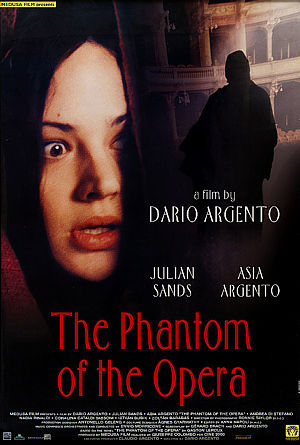 PHANTOM OF THE OPERA - 1998 PHANTOM OF THE OPERA - 1998Italy Release: Nov. 20, 1998 USA Release: Nov. 9, 1999 (wide) Medusa Distribution / A-Pix Entertainment Rating: Finland: K-16 / France: -12 / Italy: VM14 / USA: R and Unrated |
||
It's no secret that I'm an Argento-phile of the first magnitude. I'm a staunch supporter of the man's films, be it his supernaturally themed stories, his gialli, or even the films he's only produced - if it has Dario Argento in the credits, I'm there. I've even stuck up for the movies in his filmography that other hardcore fans dislike (TRAUMA, STENDHAL SYNDROME). I only mention this in order to give the following review weight. I hold Argento's films up to a higher standard than those I use to gauge the average genre director's work, and in spite of that, he's never failed to blow me away. So, when it was announced that his latest film, 1998's PHANTOM OF THE OPERA, would finally get a video and DVD release here in the States, few folks were more excited than I.
This film, horror's latest updating of Gaston Leroux's classic novel (the last was 1989's abominable PHANTOM OF THE OPERA starring Robert Englund), takes some liberties with the standard storyline. The Phantom (Julian Sands: GOTHIC, ARACHNOPHOBIA, WARLOCK, WARLOCK 2, BOXING HELENA, NAKED LUNCH) was an abandoned child, dumped into an underground river, and raised by the rats who saved him (in a scene stolen almost directly from BATMAN RETURNS, only with rats instead of penguins). Years later, he's still haunting the catacombs underneath an Italian Opera house, when he hears the singing of Christine (Asia Argento: TRAUMA, THE CHURCH, DEMONS 2). The Phantom falls in love with the young understudy, and will stop at nothing to make her the opera's main attraction - including murder.
Unlike the classic, this Phantom doesn't wear the trademark mask since his disfigurement is on the inside. While Sands manages to make the character somewhat sympathetic in parts, his strange predilection for sexual stimulation from the rats (while a naked Asia Argento is in the other room, no less) makes him a hard guy to truly identify with.
The film's performances are of varying quality. Sands does a solid job portraying the driven Phantom who's both a little crazy and a little romantic. Asia Argento's performance, on the other hand, leaves something to be desired. Once again, she plays a character who's little more than a lusty nymphet. Even worse is her lip-synching in the opera scenes. It's painfully clear that she's not singing the lines, so one wonders why she wasn't better prepared for the singing part of the role or why Argento insisted on shooting tight shots of her operatic performances (he went with wide angle shots in TERROR AT THE OPERA). Andrea Di Stefano (VENDETTA) turns in a nice performance as Raoul, the other man vying for Christine's affections, and Nadia Rinaldi provides light comic relief as the opera's star, Carlotta.
The film has some interesting visuals, but most of them seem to have little to do with the movie's narrative. Argento takes us to a bathhouse where everyone is either slim and attractive or grossly obese. Another subplot deals with the opera house's resident rat catcher, Ignace (István Bubik: SUNSHINE) and his midget cohort, Dwarf (Sandor Bese: WERKMIESTER HARMONIES). Unhappy with the number of rats he's catching, the exterminator develops a motorized rat-catching car. The car looks like something straight out of a Terry Gilliam film, and despite the scene's gruesome ending, it feels too lighthearted to fit in with the rest of the brooding plotline. Other visuals seem to clearly fit in with the narrative, but appear either needlessly obvious or surreal. When the Phantom imagines a bunch of fat men squirming in a mousetrap, the meaning is fairly clear. Of course, we could gather that the Phantom was a bit crazy when he's brutally murdering people, so it's sort of a pointless scene. At any rate, the film lacks the striking visuals of earlier Argento works like SUSPIRIA and INFERNO.
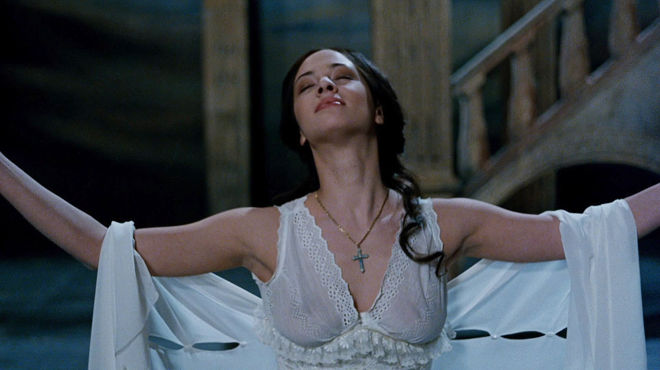
I shaved my armpits for this!
Sergio Stivaletti (CEMETERY MAN, WAX MASK, and STENDHAL SYNDROME) creates a wide range of FX shots, most of which are quite good. We're treated to a man torn in half, an impalement on a stalactite, a ripped out tongue, and a decapitation amongst other things. One of the film's larger FX sequences, where a large chandelier crashes on an unsuspecting audience is an interesting idea, but unfortunately, the execution doesn't work. CGI was employed to show the cracking ceiling and the falling fixture, and like most CGI, it looks like computer generated graphics as opposed to the real thing. The gore-laden extras smashed under it in the cut shot are fair, but not gruesome enough to save the sequence. Also noteworthy in its cheesiness is a large animatronic rat at the film's beginning. The rat wouldn't have been so bad if they'd have forgone the glowing red eyes. Still, the weakness of these two FX shots aside, the film does deliver some good, realistic looking grue.
Ennio Morricone (THE THING (1982), STENDHAL SYNDROME, DARIO ARGENTO'S WORLD OF HORROR) provides the film's score, most of which is fairly forgettable. The opera sequences are decent, provided that you can listen to opera, but otherwise the music is sort of flat and unimpressive - more background filler than the rousing atmospheric pieces in the majority of Argento's works. On the plus side, there's none of the cheesy heavy metal music that Argento seemed so infatuated with a few years back.
A-Pix has brought the title to American audiences in both an R rated and unrated version. Naturally, you should see the unrated version if at all possible. I'm not certain that the unrated version is completely uncut (there was a slight discrepancy in the running times, but this could be partially because of the difference PAL/NTSC frame rates - which is one of those topics that's slightly beyond me). The A-Pix DVD is hardly the nicest disc you'll ever see, being that it's marred by some pretty nasty pixelization. Even worse is the long arduous process I had to go through to get the widescreen version of the film to work. It seems that you have to go into your player options and switch them to widescreen in order to get the player to read the film in that aspect ratio.
PHANTOM OF THE OPERA marks Argento's second foray into the world of artsy divas. Unfortunately, it falls well short of the mark he established with his earlier film, TERROR AT THE OPERA. Phantom suffers from a thin plot, and more importantly, an antagonist who's not nearly menacing enough. It's a film that shows what could have been some interesting new twists on the source material, but ultimately, they're never really developed. Argento instead opts to explore the weird attraction between the Phantom and Christine, as well as adding in the standard love triangle. From a lesser director, the film's shortcomings would have been more forgivable. However, horror fans expect more from a director of Argento's stature, as well they should. This is clearly a lesser work in the man's canon.
Rating: 3 Shriek Girls

This review copyright 1999 E.C.McMullen Jr.

|
| GET SOME CLOTHES ON | |
| YOU MIGHT ALSO ENJOY | |||
 |
 |
 |
|
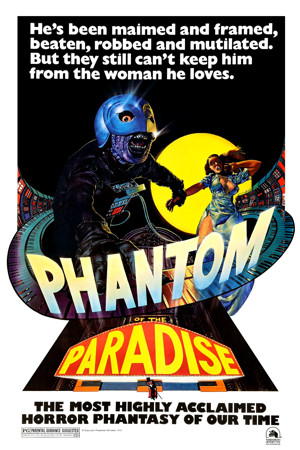
| THE PHANTOM OF THE PARADISE MOVIE REVIEW |
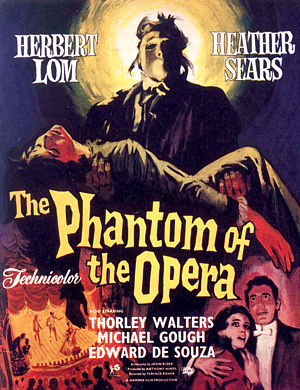
THE PHANTOM OF THE OPERA - 1962 MOVIE REVIEW |
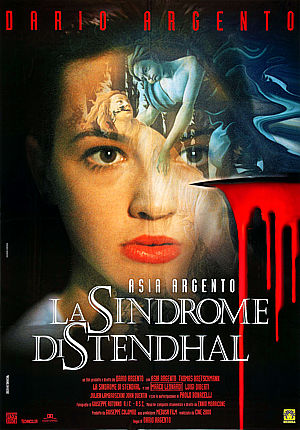
THE STENDAHL SYNDROME MOVIE REVIEW |
|
| FEO AMANTE'S HORROR THRILLER Created by: E.C.MULLEN JR. |
| COME FOLLOW ME @ Amazon |
| ECMJr |
| Feo Blog |
| IMDb |
| Stage32 |
| YouTube |
| Zazzle Shop |