 |
 |
Review by Christos N. Gage |
|
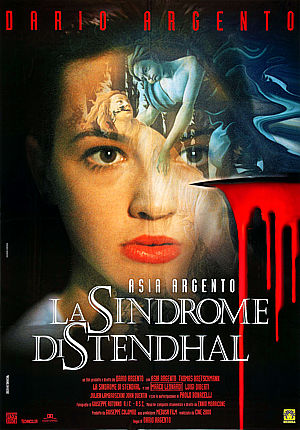
USA Release: May 18, 1999 Medusa Film, Cine 2000, A Troma Team Release Rated: USA: R |
|||
Though not as widely known in the US, Italian director Dario Argento is considered by film buffs to be one of the world's true masters of horror. He proves he still deserves that title thirty-plus years into his career with THE STENDHAL SYNDROME, a highly disturbing and truly horrifying psychological thriller.
American horror audiences are used to gore. We've seen buckets of blood, gobs of guts, and every imaginable violent act displayed in widescreen detail. We may consider ourselves jaded to such things. But I defy you to watch THE STENDHAL SYNDROME and not turn away, or at least feel genuine revulsion, at several points in the film.
Asia Argento (LA CHIESA, TRAUMA, IL FANTASMA DELL'OPERA, Dario's daughter) stars as Anna Mani, a police detective on the trail of a serial rapist/murderer. She tracks him to Florence, where she receives a tip that he'll be at the Uffizi museum. With a police composite sketch of the rapist to refer to, she heads for the museum, hoping to capture him. But, while perusing the art there, she finds herself overcome by an unusual psychological phenomenon called the Stendahl Syndrome: a reaction to artwork that makes the viewer suffer hallucinations, disorientation and unconsciousness. Anna collapses. Suffering from temporary amnesia, she is helped into a cab by a young man named Alfredo (Thomas Kretschmann: BLADE II).
Back in her hotel, she tries to pull herself together, only to be attacked by Alfredo - the rapist she's tracking - who stole her gun and room key while supposedly helping her. During a brutal rape at the hands of Alfredo, Anna blacks out. She awakes in the back seat of a car to the sound of screams as Alfredo rapes and murders another victim. While he's occupied, Anna escapes.
I've seen several of Argento's movies, and one of his trademarks is filling his films with surreally shot, highly graphic scenes of violence. There are a few of these here, like when the camera follows a bullet into a victim's head, through it, and out the other side. But what makes this film work is that the focus remains squarely on Anna.
After the attack, Argento spends a great deal of time on how Anna copes with not one but two devastating psychological traumas: the rape and the Stendahl Syndrome. She starts seeing a psychiatrist, and cuts her long hair short. When her boyfriend, fellow policeman Marco (Marco Leonardi: IM SOG DES BOSEN, FROM DUSK TILL DAWN 3: The Hangman's Daughter), pressures her for sex too soon after the rape, she responds by saying "You want to fuck? How about I fuck you?", slamming him face first against a wall, yanking down his pants and treating him like the new kid on the cell block.
Alarmed by her violent outbursts and mood swings, and the knowledge that Alfredo is still out there somewhere, Anna takes her therapist's advice and journeys to her hometown for some downtime. Her repressed father (John Quentin) and clueless brothers aren't much help, but the round-the-clock police guard is some comfort, as is fact that the local museum is closed for renovation. Anna spends her time at the gym sparring with her brother (and kicking his ass), and doing some painting of her own as part of her therapy.
But, inevitably, Alfredo tracks her down.
He kills Anna's guards and knocks her unconscious. She wakes up tied to a mattress in an abandoned tunnel once used by junkies to shoot up. Alfredo spends all night assaulting her, and before he leaves for the day, he makes it clear he's going to be back again and again. Once she's alone, Anna descends into a horrific episode of THE STENDHAL SYNDROME touched off by the graffiti art in the tunnel, an episode which seems as terrifying to the helpless Anna as the rape itself.
Alfredo returns later for round two. But by now Anna has freed herself. She stabs him in the neck with mattress springs, shoots him in the gut, and beats him to a pulp, taunting him the way he taunted her, before kicking him off an embankment into a river below, where he is swept out of sight.
At this point, the jaded filmgoer will groan knowingly, anticipating Alfredo's inevitable return just when all the characters think he's dead. And when Anna starts feeling like she's being watched just as she's finally allowed herself to fall in love again (with a French art student), it seems that's where we're going. But Argento is not one to recycle old clichés. The ending of the film is the logical, inevitable result of what has come before.
My gripes about the film are few.
It's dubbed, and I would have preferred subtitles (or the option to choose between the two), because to me, every dubbed film I've ever seen sounds like a cheesy Kung Fu Theater flick. There are also a few moments that just make me go "Huh?" like when Anna, hallucinating that she's entered a painting of an ocean scene, imagines herself kissing a large fish. But I've found you're going to get some of that with any European film. The biggest issue for me is that it might just be too disturbing. I'll watch THE SILENCE OF THE LAMBS any time, but I doubt I'd want to see this again. Not because it's not well done; perhaps because it's too well done.
TRIVIA To give his score the creepiness he felt this movie needed, Ennio Morricone wrote it to sound the same played forward or backward. Stendhal Syndrome is real and Dario Argento personally suffered from it in his youth, although he wasn't aware of what his problem was at the time. |
The good points are many. Asia's performance is outstanding, showing that she truly deserves the international stardom she's gone on to as an actress (look for her in the upcoming Vin Diesel vehicle XXX). She's tough, but vulnerable, and the rape scenes are among the most unpleasant I've had to watch on film, especially knowing that the actress is being directed by her own father. The direction and camerawork are eerie, and the music by the venerable Ennio Morricone (immortalized by his famous "ooweeooweeoo, wah wah wa" from The Good, The Bad, And The Ugly) adds strongly to the disconcerting atmosphere.
There are plenty of extras on the DVD: biographies, commentaries, and interviews with Dario Argento and his associates. You'll also find a slew of Troma promos and goodies. The latter, with their gleefully anarchic Toxic Avenger flavor, seem out of place (Julie Strain's performance of the Troma Rap?!?) when paired with a pretty serious horror film, but no one's forcing you to watch them, and I can't blame the low-budget film house for promoting themselves any way they can.
The interviews are informative, especially the ones with Argento, although I did realize one thing while watching them. Though Argento speaks excellent English, his first language is Italian, and I feel like he could have articulated himself better if he'd spoken in Italian and had his words translated by an expert. I speak Greek well enough to get around Athens (or Astoria, Queens), but I can't express myself in that language nearly as well as I can in English. I'd love to see a discussion with Argento in which he's more concerned with what he says than how to say it. Still, these are nit-picky things.
The point is, this is a horror film, and it's one of the most hard-hitting I've seen in a while.
Overall, THE STENDHAL SYNDROME is a gripping, disturbing, and truly horrifying horror film that gets
you in the gut. I give it four Shriek Girls.

This review copyright 2002 E.C.McMullen Jr.

|
| DRESS NICE | |


| FEO AMANTE'S HORROR THRILLER Created by: E.C.MULLEN JR. |
| COME FOLLOW ME @ Amazon |
| ECMJr |
| Feo Blog |
| IMDb |
| Stage32 |
| YouTube |
| Zazzle Shop |