

When You Buy My Books
E.C. McMullen Jr.
PERPETUAL
BULLET
 "'Some People' ... may be the standout story in the book."
- John Grant, Infinityplus
E.C. McMullen Jr.
WILLOW BLUE
 "'Willow Blue' will burrow under your skin and stay there long after you've put the book down."
- Jeffrey Reddick, Creator of
FINAL DESTINATION
IN OTHER BOOKS
E.C. McMullen Jr.'s
short story
CEDO LOOKED LIKE PEOPLE
in the anthology
FEAR THE REAPER
 "This Ray Bradbury-esque is one of the most memorable and one of the more original stories I've read in a long time."
- Steve Isaak,
Goodreads
HORROR 201:
The Silver Scream
 Filmmaker's Guidebook
featuring
RAY BRADBURY,
JOHN CARPENTER,
WES CRAVEN,
TOM HOLLAND,
E.C. McMULLEN Jr.,
GEORGE A. ROMERO,
and many more.
Extensively quoted in
 PHANTASM
EXHUMED
The Unauthorized Companion
Robert S. Rhine's
SATAN'S 3-RING
CIRCUS OF HELL
 Forward by
GAHAN WILSON &
FEO AMANTE.
Featuring comics by
ALEX PARDEE,
WILLIAM STOUT,
STEVE BISSETTE,
FRANK DIETZ,
JIM SMITH,
FRANK FORTE,
ERIC PIGORS,
MIKE SOSNOWSKI,
OMAHA PEREZ,
DAVID HARTMAN,
STEVEN MANNION,
and more!
And In
CINEMA
E.C. McMullen Jr.
Head Production Designer
 MINE GAMES
(Starring:
JOSEPH CROSS, BRIANA EVIGAN,
ALEX MERAZ)
Dept. head
Special Effects Make-Up
(SFX MUA)
 A SIERRA NEVADA
GUNFIGHT
(MICHAEL MADSEN & JOHN SAVAGE).
Production Designer
 UNIVERSAL DEAD
(DOUG JONES,
D.B. SWEENEY,
GARY GRAHAM)
Art Director
 THE CRUSADER
(COLIN CUNNINGHAM,
GARY GRAHAM)
 |
 |
SCIENCE MOMENT by E.C.McMullen Jr. |
||

Story: Travis Milloy, Christian Alvart Screenwriter: Travis Milloy Director: Christian Alvart Producers: Paul W.S. Anderson, Jeremy Bolt, Robert Kulzer, Martin Moszkowicz Studios: Constantin Film Produktion, Impact Pictures I Get Email |
||||
The stupidity in this movie begins with the opening narration. At one point we are told,
175 years later, as we colonized the galaxy, the population on the earth was this big and we had to look for new earth-like planets because earth ran out of resources.
We have the capability to colonize the entire Galaxy!
The entire galaxy is at our disposal and earth still runs out of resources? WT Flying F?
Dumbfoundingly, it gets worse.
Science and technology aren't always the same thing. Science can be about hypothesis, theories, concepts and ideas that have no real world applications. Technology on the other hand, deals with solving scientific engineering problems that produces actual material results. I'd like to focus on a major plot device in PANDORUM which employs the ever present use of Chem-lights.
Chem-lights or Chemiluminescence (chemically created light), patented by Omniglow and manufactured in 1986 under such names as Cyalume and Snaplight (to name a few), is an old technology based upon chemical reaction. You break a chemical containing capsule, which is floating in another chemical, and when the two touch they produce light for a short period of time (the atoms get excited upon meeting each other, but eventually lose interest). When the chemical reaction stabilizes and becomes inert, the light goes permanently "off".
Would this old tech still be around in 175 years? Unlikely as the tech is already moving into obsolescence by recent advances such as Electroluminescence, from companies such as CK Krill light sticks. Krill take up no more room than chem-lights, and produce illumination that can last as much as 27 times longer than chemlights - and you don't break anything. But even those will soon be obsolete due to the type of old fashioned battery it uses.
Modern advances in longer life battery storage (since 2005 we've had batteries that can be ink-jet printed onto paper), ever advancing nanotechnology, and even the ability to genetically and safely make animals produce their own light, makes the idea of future astronauts, nearly two centuries from now, having to rely on something as quaint as a chem-light, amusing in a mocking-your-movie kind of way.
Imagine watching a movie about the ISS space station. The power goes out and the researchers onboard have to rely on light from a... whale oil lantern? Seriously, wouldn't it still seem out of place for researchers on a modern day space station to rely on candles or the more relatively modern tech of a kerosene lantern? And yet in PANDORUM, there they are, almost 2 centuries into the future, aboard an intergalactic starship, and running around with something as anachronistic as Snaplights.
It made sense in DESCENT, because that film takes place in the now, not the nearly 200 years from now.
As for the beginning of PANDORUM and our earth having too many people and so, running out of resources?
Consider that the film makes plain from the very start that in the future, we are flying all over the solar system.
All Over It.
Then we are flying around OTHER solar systems. In our solar system alone, there are enough minerals, gases, and even water to amply supply the needs of as many people as could be living on earth. In fact, there is so much that you could build several more entire earths!
Earth, if you haven't noticed, is quite tiny when compared to other planets in the solar system. And even with all of this abundance of resources within in our solar system? That doesn't even include the massive resources on the outer reaches of our solar system in the Kuiper Belt~, which surrounds our planetary solar system. And even the Kuiper Belt is within the larger Scattered Disc, which surrounds that.
What's more, there is the hypothesized massive Oort cloud^ that may contain our relatively disc shaped solar system, and its belt, within its sphere. In fact, the Oort cloud may extend about 3 light years in all directions. Even if it should turn out that the Oort doesn't exist, between the planets, the debris, and the Kuiper and Scattered Disc, we may leave our solar system to colonize other planets, but there will never be a reason to leave our solar system because we ran out of resources On Earth.
Also, we have the technology to terraform planets and build spaceship colonies Right Now (which is what the "colonists" must be doing and, actually, we've had terraforming ability since the 1970s). The problem isn't technology, the problem is justifying the cost. In fact, the Chinese government is planning, Right Now, to colonize and terraform the Moon and Mars (they've been quite public about it *). So why, nearly two centuries from now, would we need to search far into our own galaxy or others to find an "earth-like" planet? When we are already, according to this movie you know, MAKING them?
If we are already busy terraforming inhospitable worlds into new earth-like planets then the easiest thing would be to reset our depleted earth back into an "earth-like" planet.
Finally, and this is the most painful lapse of science, the Elysium is supposedly in another solar system. No solar systems near us have earth-like planets. They don't even have Sol-like stars. Yet the spaceship is also supposed to be 500 million miles from earth.
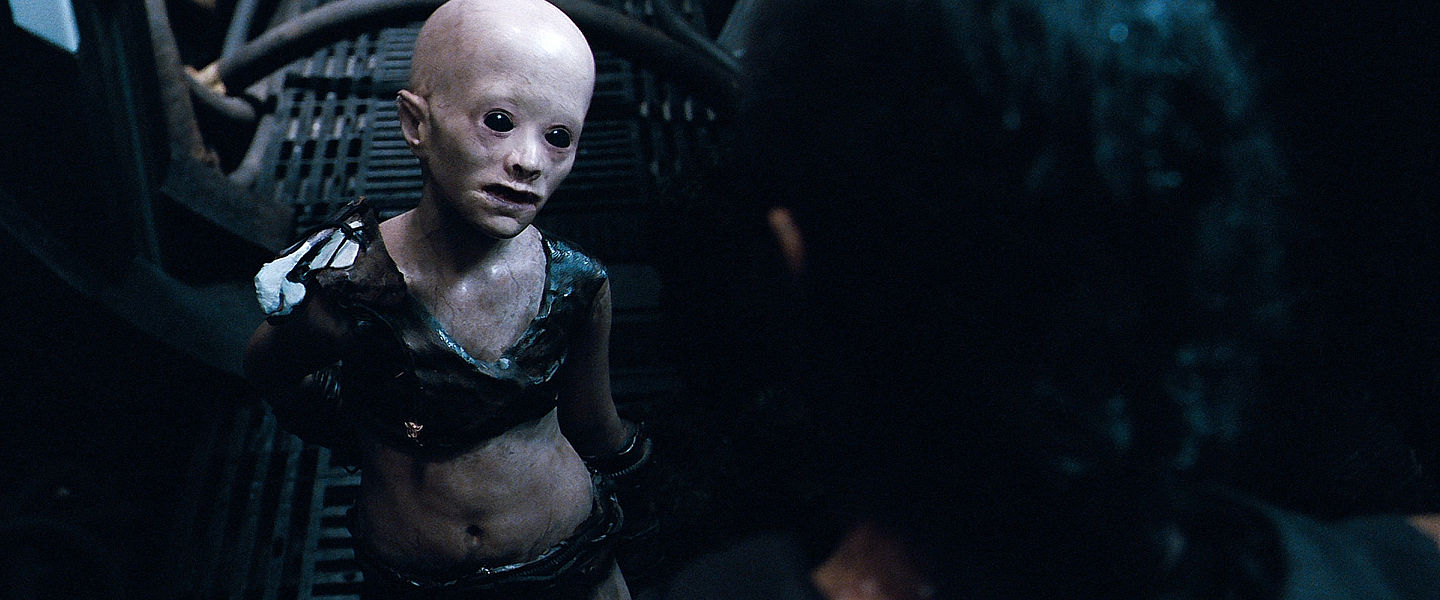
You just ran for your life from about 50 of these things!
The "Kid" is sneaking up on you, holding its hand behind its back!
ITS HAND IS BEHIND ITS BACK!
Why are you moving closer like this cannibal child is SO Adorable?
HEY STUPID!
ITS HAND IS STILL BEHIND ITS BACK!!!
Ahem.
Which puts the Elysium somewhere between the orbits of Jupiter (483 million miles from the sun) and Saturn (837 million miles). I swear to you, there are no other solar systems In Our Freaking Solar System!
Also, the ship has traveled for 923 years and has only gone 500 million miles? That's just a little under 62 miles an hour! The hell?
Maybe they meant 500 billion miles? Again, I swear to you that there are no other solar systems In Our Solar System!
Including the hypothetical Oort cloud and scattered disc, from end to end our solar system alone is well over 17 TRILLION miles across. And whether or not there actually is an Oort cloud, for a fact there are no other solar systems in that whole region. Any other star within 3 light years of us would be plainly visible in the daytime sky, as well as having a profound effect on our own solar system.
To understand just how bonehead sloppy the writing was (The Elysium is 500 million miles from earth? Uranus is nearly 2 billion miles from earth, and we still have Neptune and then Pluto!), and to have a better idea of the distances involved, read The Distance Between Us.
~
Discovered in 1992 by MIT astronomer David Jewitt and then-graduate student Jane Luu, and named after Dutch born, American Astronomer, Gerard Kuiper.
^
The Oort cloud is named after Dutch Astronomer, Jan Hendrick Oort.
*
How Terraforming Mars Will Work
China's ambitious plans in space
China may set up moon base camp by 2030
When it comes to Science Fiction movies, PANDORUM was one of the most uneducated pieces of drivel I've seen in years. And when you think of all of the poorly educated Hollywood Science Fiction movies, and especially in a year that saw the SciFi fantasy release of the all new STAR TREK, (the black hole needs to be inside the planet to do any damage? Seriously?) that's saying something. Yet even the most witless Science Fiction movies can engage scientific debate. Possibly because there is so much wrong that it takes so much to set right. I received the following email from Feo Amante visitor Pierre Fabre. While it is his email and words, his thoughts might be shared by many who read my review and Science Moment. |
Subject: Pandorum Science Moment----Science Nerd? Some cosmology corrections: you state that any other star that was THREE LIGHT YEARS away, "would be plainly visible in the daytime sky, as well as having a profound effect on our own solar system." Sure, they maybe aren't at THREE light years, but alpha proxima is 4.1 light years away and the STAR SYSTEM alpha centauri is 4.3 light years (about 41 trillion miles) away, and they have none of the 'profound effects' you predict. Light years are fairly large units of measure. If you need to hire a science nerd to check your facts I'd be happy to help. cheers, Pierre Fabre ps. Also in the same article: earth is the largest rocky planet in our solar system and I don't really see us mining gas giants such as jupiter, saturn, uranus, or neptune within a couple of hundred years....the gravitation involved is prohibitive to say the least, so, no, we are not a tiny planet in a solar system abundant in large ones....we are, in fact, sitting on the largest of the colonizable, minable, planets. |
Hi Pierre, I hope you are enjoying my website. Now my response to your letter. Pierre: "Light years are fairly large units of measure." Feo: Indeed they are. They are so large, that if the Alpha Centauri star system were just 1.3 light years closer, it would be siphoning matter off of the Oort cloud, which in turn would siphon matter off of our scattered disc, which in turn would siphon from the Kuiper belt, which would have a profound effect on our solar system (unless the Oort cloud doesn't exist, which would add to our understanding of our solar system). But in reality, the closest star, over a light year from the farthest theoretical reaches of our solar system, isn't close enough for its gravity to profoundly affect us. Also, a light year is 5,903,026,326,254.67 miles. If YOU need to hire a science nerd to check YOUR facts I'd be happy to help. :) Pierre: "I don't really see us mining gas giants" I made no mention of us mining gas giants. Understand that the grand total of all of our mining, all of our digging and building, metals, coal, everything, from the very beginning in prehistoric times, 43 thousand years ago (Lion Cave, Swaziland), accounts for much less than 1% of the earth's total exposed surface. I'm not even talking about the 2/3rds covered by water and the earth's total crust (about ten miles thick overall). I'm just talking about the surface: few mines go even 1 mile deep. At least 43,000 years of mining! When it comes to resources, we have truly barely scratched the surface. So there is ample mining to be done on other moons. What little there is scattered in the asteroid belt alone could possibly serve us and our advancing technology for the next one thousand years. That doesn't take into account terraforming and colonizing Mars or building space colonies. And we still have the resources of moons around Jupiter, Saturn - just those alone would be more than enough for us to build and colonize space in O'Neill ships. Hard core Science Fiction writer, Fredrick Pohl's 1992 novel, Mining the Oort, supposed exactly what I mentioned in my Science Moment. In his novel, the hypothetical Oort cloud has more than enough for all of the colonized planets and colony ships. More on the stars of the Alpha Centauri system. MINING THE SKY: THE HIGH FRONTIER: ISLANDS IN THE SKY: ENTERING SPACE: CENTAURI DREAMS: Imagining and Planning Interstellar Exploration |
Thanks for visiting Pierre! I hope you'll continue to enjoy Feo Amante's Horror Thriller and The Science Moment!
This review copyright 2009 E.C.McMullen Jr.

|
| GET COVERED | |


| FEO AMANTE'S HORROR THRILLER Created by: E.C.MULLEN JR. |
| COME FOLLOW ME @ Amazon |
| ECMJr |
| Feo Blog |
| IMDb |
| Stage32 |
| YouTube |
| Zazzle Shop |