 |
 |
Article by |
The PSYCHO Sequels
By James Futch

Soundtrack
| PSYCHO MOVIE REVIEW |
| PSYCHO II MOVIE REVIEW |
| PSYCHO III MOVIE REVIEW |
Bernard Herrmann's shrieking violins from the original PSYCHO became a crucial player in the movie, just as John Carpenter relied heavily on music to create the suspense in HALLOWEEN. The PSYCHO theme is as recognizable as the theme from JAWS, and utterly essential to the film. It is impossible to imagine it with any other score besides Herrmann's.
PSYCHO II, which expands Norman's sympathetic character as well as the mythos of the original, needed a new composer. The working idea during production was to use bits and variations from the Hermann score (Universal Pictures still owned the rights) "but as the picture emerged and began to assert its own personality, it became evident that it would not work," said Richard Franklin.
Jerry Goldsmith, Franklin's favorite composer, was the first choice for the job. Goldsmith is a name familiar to movie fans. He provided the scores for everything from the original PLANET OF THE APES to PATTON and CHINATOWN. Horror fans will recognize him as the soundtrack composer of ALIEN, THE OMEN, and POLTERGEIST.
On the MCA soundtrack album sleeve, Richard Franklin explained the reason for his choice of Goldsmith to pen the music:
"The main theme of PSYCHO II is innocence… murderer or not, Norman Bates was, and is, an innocent. Although he's been locked away and given the burden of self-knowledge, his incarceration also preserved the innocence of the Norman Bates, who twenty two years ago was shocked by his "mother's" actions …this quality is present in the main theme [of the soundtrack] …Jerry's score is the heart of PSYCHO II."
Indeed, the soundtrack ranges from beautiful, innocent orchestrations to dark driving suspense pieces. The most notable pieces on the soundtrack are the Main and End titles, a quiet and mournful piano composition with a crest of lush orchestration.
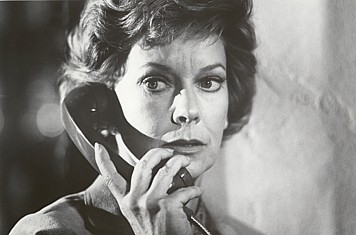 Vera Miles Returned as Lila Crane. |
The Cast
PSYCHO II welcomed back Vera Miles, who reprised her role as Lila, the bossy and compulsively brave little sister of Marion Crane in the first film.
The actress described to the press the feeling on the set of PSYCHO II, "It was kind of weird to be back in the PSYCHO house after all these years and back on the sets they have duplicated so much. It gave me a little déjà vu occasionally, and I found myself expecting Hitch to round the corner."
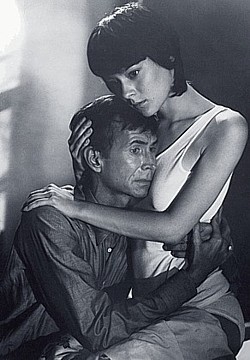 Anthony Perkins enjoys Meg Tilly's toasted cheese sandwich scented cologne. |
New to the cast was Meg Tilly, star of AGNES OF GOD and THE BIG CHILL. Tilly portrayed the young and dreamy Mary Samuels, the girl who moves in with Norman, and grows to empathize with him. Of the many characters she has played, Tilly said,
"Mary is the most complex of all. She was a real challenge because of the many interwoven pieces of her personality that interplay and shadow her character."
New Yorker Robert Loggia has appeared in over a hundred films over the last 50 years and known by his many scene stealing supporting roles in films like BIG and SCARFACE. In PSYCHO II, Loggia played the gruff Dr. Raymond, Norman Bates's psychiatrist at the institution.
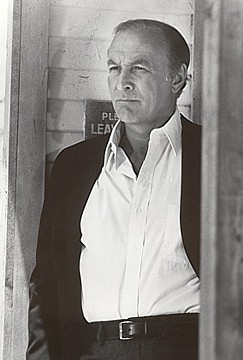 Robert Loggia plays Dr. Bill Raymond, Norman Bates's psychiatrist in PSYCHO II. |
If any one ingredient was imperative to the making of PSYCHO II, it was Anthony Perkins's reprisal of the role he made famous in 1960. Thankfully, the magical and underrated actor liked Tom Holland's script and picked up the role of Norman Bates after 22 years.
Anthony Perkins was born on April 4, 1932, son of stage and screen actor Osgood Perkins. The family settled in Massachusetts when Tony was 12. He moved to Florida to attend Rollins College as a history major, while spending the summers as an actor in stock companies.
In 1953, he hitchhiked to Hollywood and landed the role of Fred Whitmarsh in THE ACTRESS, a turn of the century comedy. The success of the film propelled Perkins into a succession of popular roles over the rest of the decade, films such as FRIENDLY PERSUASION (1956), FEAR STRIKES OUT (1957), and ON THE BEACH (1959).
But in 1960, he landed the role of a lifetime, one he would be identified with for the rest of his career. The role, of course, was Norman Bates.
Although the Norman in Robert Bloch's novel was a pudgy fellow around the age of 40, Hitchcock pitched the idea of Anthony Perkins to screenwriter Joseph Stefano. Stefano liked the idea, and wrote the script accordingly, with a thinner and younger Norman Bates.
Author Stephen Rebello wrote in his in-depth book "Alfred Hitchcock and the Making of Psycho", "Joseph Stefano's screenplay describes Norman Bates as "somewhere in his late twenties, thin and tall, soft-spoken and hesitant… [with] something sadly touching in his manner.""
Perkins was in fact something of a teen idol during the mid to late fifties, with his handsome mug plastered on many teen fan magazines. Girls flocked around whenever he was spotted on the street, and in addition to his film excursions, he released of string of mildly popular Top-Forty hits, most notably "The World is Your Balloon" and the Hawaiianesque "Moonlight Swim".
But in spite of his status as a bubble gum idol, there was a Johnny Deppishness about Perkins that drove him to unconventional roles and he was ready to take on the part of a cross dressing, mother fixated serial killer. And it wasn't even the 1960's yet.
After the huge success of the film, Perkins's career traveled to Europe as American audiences seemed unable to accept him in any other role and he began to take pains to avoid the association. But by 1982, he had come to terms with his alter ego, and was ready to accept that Norman Bates was his Hamlet, the role he was born to play.
"[My wife] told me the more I resisted the comparison the more people would come away from the encounter thinking Norman and I were exactly the same…it's never bothered me since that day," Perkins told CV Drake in CINEFANTASTIQUE in 1986.
Anthony Perkins admits to helping create the infamous role back in 1960 when Hitchcock simply handed the 27-year-old actor a wad of money and instructed him to purchase some clothes that he thought a guy like Norman might wear. Perkins went shopping and came back with Norman's trademark corduroy pants and jacket and, for the scene with Arbogast (Martin Balsam), a black turtleneck sweater. Through the magic of moviemaking, those same clothes are used again in the PSYCHO sequels.
It was also the inspiration of Anthony Perkins, that Norman constantly munch on Kandy Korn, that Halloween confection resembling kernels of corn that chickens might peck. How he arrived at this sweet treat is unknown to me. But Hitchcock agreed that it would be a fine idea and thus, Norman can be seen nervously nibbling away in the original as well as in the sequels.
As Norman Bates, older and presumably wiser after 22 years in Atascadero Mental Institution for the Criminally Insane, Perkins said, "I liked this script… it's a very good part. I don't think I've ever played anyone quite like him. Of course, Norman has changed after 22 years in an institution. He's more educated about himself now and has the knowledge that he has the potential of being dangerous… this is Norman's story. He is very trusting and generous of spirit. He's a likeable guy with some very winning qualities. I think the audience will feel compassion for him."
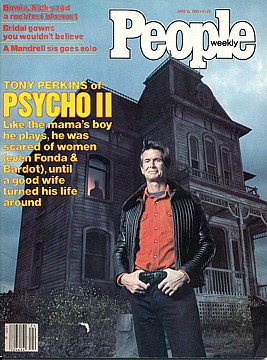
Indeed Norman is much more sympathetic in this second incarnation. The film delves deeper into Norman's past and his psyche, with poignant, emotionally dramatic results, particularly the scene in which Mary comforts Norman as he tearfully reminisces about his childhood. These insights and expansions of the character are what make PSYCHO II a worthy entry in the Bates Motel Hall of Fame.
It's a Wrap
Thanks to a hungry publicity machine, PSYCHO II was a box office smash, with positive critical reviews that mostly expressed surprise at how the film differed from expectations.
"If you've seen PSYCHO a dozen times and can recite the shots in the shower scene by heart, PSYCHO II is just not going to do it for you. But if you can accept this [movie] on its own terms, as a fresh start, and put your memories of Hitchcock on hold, then PSYCHO II begins to work," wrote Roger Ebert, "it's better than your average, run of the mill slasher movie."
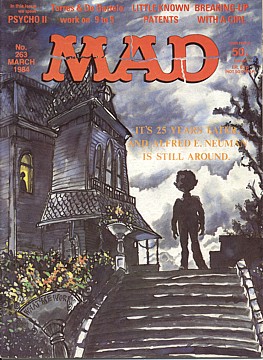
PSYCHO II also put Anthony Perkins back on the covers of U.S. magazines, only now they were Fangoria and Cinefantastique as well as People and even MAD Magazine.
Despite its somewhat convoluted and sometimes yawning plot holes, PSYCHO II helped to expand the PSYCHO lore built up over two decades as well as delve deeper the mystique of Norman Bates, psycho killer. Rather than resorting to a remake, as many horror franchises are wont to do, PSYCHO II took the story and characters in new directions.
For some people, it was STAR WARS…
When I first saw PSYCHO on TV and PSYCHO II in theatres, I was 12-years-old, the same age as Richard Franklin when he saw PSYCHO for the first time. No, I'm not a film director nor do I harbor any aspirations of ever becoming one. I only make the comparison because of the tremendous (and at once disastrous) impact that the film made on me, undoubtedly helping to drive me to where I am today, for better or worse. I was starting to truly appreciate the horror genre around that time and leafed endlessly through magazines and books on the subject. I was intrigued with the classic monsters from Universal's Horror Hey-Day in the 1930's and 40's. At the same time, I was enjoying the 'slasher' flicks that were becoming popular in the late 70's and early 80's. Jason Voorhees was scary, but not as scary as Michael Myers. And the miner guy from MY BLOODY VALENTINE, I sort of remember him. However, none of those monsters fascinated me like Norman Bates. He was a totally new monster, possibly with shades of Larry Talbot, that tortured dual soul, but one I hadn't seen before.
Norman Bates was a complex character whose struggles went beyond simply choosing between a machete and spear gun to execute libidinous youth. In PSYCHO II, we see new obstacles thrown in his path as he tries to put his life back together after 22 years of confinement. Maybe he wasn't ready to get out, but as Dr. Raymond (Robert Loggia: INNOCENT BLOOD) mutters at the beginning of the movie, "…I just wish there hadn't been all those budget cutbacks…"
And those same cutbacks are the reason there will be no "trained social worker" to look in on Norman, leaving him with plenty of ample time to go mad. He must confront the past as he settles back into the old house and readies the motel for business. Lila Loomis, whose plate of revenge is stone cold, is not making things any easier. She goes to outlandish lengths to destabilize the recovered psychopath so that he will return to his murderous ways.
PSYCHO II was rated R but the old guy in the box office didn't even look
at me as he handed me the ticket. I took a seat in a nearly empty
theatre and munched on popcorn as I wondered what Norman Bates would
look like 22 years after PSYCHO and how he would he act considering
that he was pretty much out of his mind at the end of the first
movie. Finally, the lights dimmed to black and the old classic Universal
logo appeared.
When the lights came on 113 minutes later, I was shell shocked and dazed.
PSYCHO II was the reason I made it my mission in life to get a VCR. I talked
my little brother into forfeiting his gifts for the year in favor
of the parents just getting us a VCR. "You'll dig it!"
I reassured him, "You'll never have to miss another episode of He-Man!"
Soon, there was a remote control that trailed across the carpet
to our mammoth wooden console TV, upon which sat a 75 lb top loading
Magnavox VCR, an antique metal beast, long since thrown away.
The next time we were at the drug store, I convinced my dad to get a movie membership, which granted the member the privilege of renting one of the movies in their vast selection of about 17 films.
PSYCHO II was one of those 17 movies.
I knew even then that renting it over and over would dwindle my funds faster than if I'd starting snorting coke on a daily basis. There were only so many leaves to rake and lawns to cut. I concluded that I needed to own PSYCHO II, in order to give it the study it deserved. Video rental and sales were in their relative infancy at that time and there was no such thing as "previously viewed copies" for under ten dollars. Rather, movies were sold at ghastly high prices and only a few places carried movies for sale. PSYCHO II, on VHS, was $79.99, average price for the short-lived trend.
As fate would have it, my father came home from a business trip with a gift. One of his co-workers, apparently a fabulously wealthy man, actually had two VCRs and made copies of the movies he rented. He gave my dad a tape with some movies he thought we would enjoy. The VHS tape was 6 hours long and contained 3 movies, all with the expected generation loss in picture quality. The movies were RAIDERS OF THE LOST ARK, TRADING PLACES, and, wonder of wonders, PSYCHO II.
And thus, the viewings began.
PAGE 5: Norman Bates is back to normal... 
PSYCHO, PSYCHO II, and PSYCHO III photos copyright 1983 and 1985 Universal Studios, Inc.
All rights reserved. May be reprinted for newspapers and other periodicals.
This article copyright 2002 E.C.McMullen Jr.

|
| 3 LAWS OF ZOMBITICS | |
| YOU MIGHT ALSO ENJOY (Sub-Section: PSYCHO and Mother's Children) |
||
 |
 |
 |
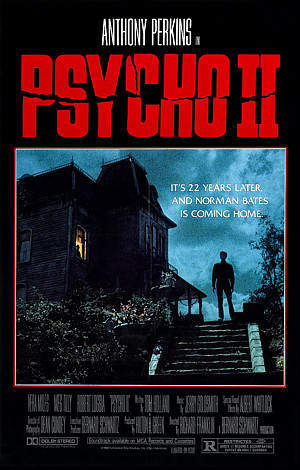
| PSYCHO II MOVIE REVIEW |
TOURIST TRAP MOVIE REVIEW |
A NIGHTMARE ON ELM STREET MOVIE REVIEW |
FEO AMANTE'S HORROR THRILLERCreated by:E.C.McMullen Jr. FOLLOW ME @ |
| Amazon |
| ECMJr |
| Feo Blog |
| IMDb |
| Stage32 |
| YouTube |
| Zazzle Shop |