 |
 |
Review by E.C. McMullen Jr. |
|||
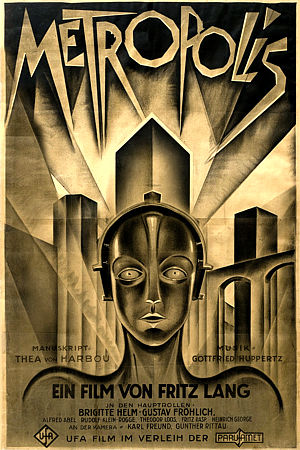
Germany: Jan. 10, 1927 USA Release: March 13, 1927 Universum Film (UFA) Rated: N/A |
|||||
My Grandpa was 35 when he started his family (stay with me here, I'm going somewhere with this).
So when I was a kid, I had a VERY old Grandpa. My Grandpa remembered silent movies and how they wowed people. He remembered the introduction of sound, and how THAT wowed people. He remembered the first color motion pictures with sound that he saw: The Wizard Of Oz and Gone With The Wind, and how that too, wowed people. He remembered the first 3D movie he ever saw, CREATURE FROM THE BLACK LAGOON. And how that intrigued, interested, and fascinated people, but didn't quite wow them. He lived long enough to experience SENSURROUND, but he didn't make it to the 1990s and so died without seeing the 3D IMAX, 5.1 Surround Sound AVATAR.
No big loss (about not seeing AVATAR), but my point here is, now that it looks as if 3D might finally stick (after over 50 years of false starts), that's an awful lot of physical, technological changes in the medium of motion pictures.
Are there any old movies that actually, REALLY deserve to be seen and heard and remade with the latest technological advances of the medium?
I mean, there are lots of remakes that have no business being remade, but are there any movies that truly deserve to be remade?
I say yes and my vote goes for this movie, METROPOLIS.
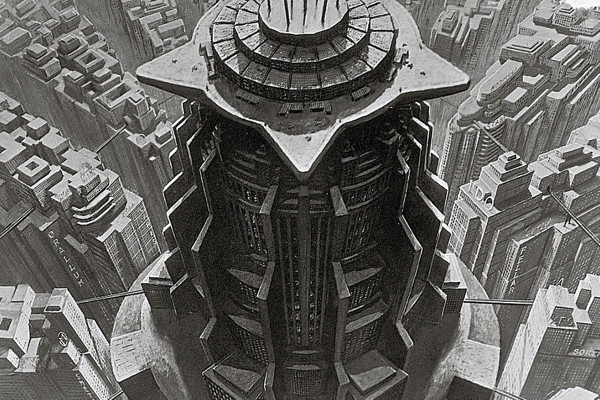
In the future, masses of men work deep beneath the extraordinary city of Metropolis. Far above the streets, high above the highest towers, in the tallest building of all, is the Club of Sons. These are the sons of the men who rule Metropolis. Freder Fredersen (Gustav Fröhlich: SECRETS OF A SOUL) is the son of the most powerful man of all: the man whose vision created Metropolis, Joh Fredersen (Alfred Abel: DR. MABUSE: THE GAMBLER, THE PHANTOM [1922]).
Freder, Motherless since birth, spends his days in idyll. He runs races with his friends, plays games of physical exertion with his friends, he delights in being the fastest, strongest, best athlete. And every day of his life is like this. And every night he woos various women who hang out in the gardens of the Club of Sons; their only reason to exist is at the pleasure of the Sons. Freder knows nothing of work or sorrow. He has no concept that how he lives is at the expense of other humans no less important than he. No one is allowed to tell him. In fact, he has no idea that other young men his age do NOT live the same as he.
Until one day.
In the rooftop Garden of Delights, as Freder holds a painted, dolled up woman in his arms and talks smack, the massive entry doors open and he is confronted by a pathetic sight. Skinny, filthy children: stunted and unkempt, moving in hesitant, hiccup motion, through the doors. They stare in wide-eyed, uncomprehending silence at the lavishly expensive beauty.
Then a woman appears. She is not dressed for attractiveness: No make-up, bling or glitter. Freder is taken aback. He is stunned that there are people who look like this; live like this. As he stands there, struck by the sight of such obvious misery and poverty, the young woman casts her arm towards all of the young affluent men and women and of all of the things she could say about such people who live like this, what she says to the children at her side is, "These are your brothers and sisters."
Freder can hardly contain his shock and is frozen to the spot. Elegantly dressed security rush to the door, ushering the woman and her entourage out. Freder approaches one of the security, asking who they were and is told not to think of it.
Those were merely people from below.
Freder was aware of those who tend the machines, but always believed that they lived carefree lives like him. He believed all people led lives as happy as his own. That is what he has always been told, this is the construct within which he was raised, and because of his powerful father, no one ever dared tell him different.
Humiliated: His world view shattered, Freder runs from The Club of Sons.
Freder descends to the depths of the city, far below where the workers of the machines toil. There are those whose job is to try and stop him, divert and distract him, but none may actually bar the way of the Son of Joh.
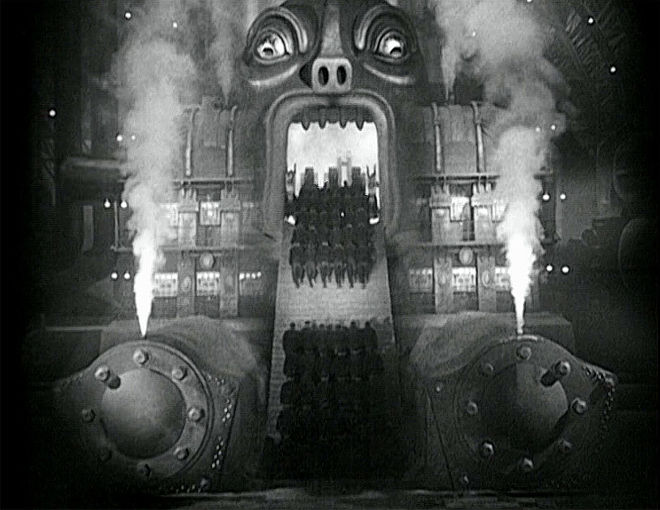
Far underground, Freder arrives at the oppressively massive machine room, where without sun or moonlight, the gigantic Heart Machine is always tended and always runs. Freder is there in time to see the exhaustion of one man cause an emergency that kills and injures many.
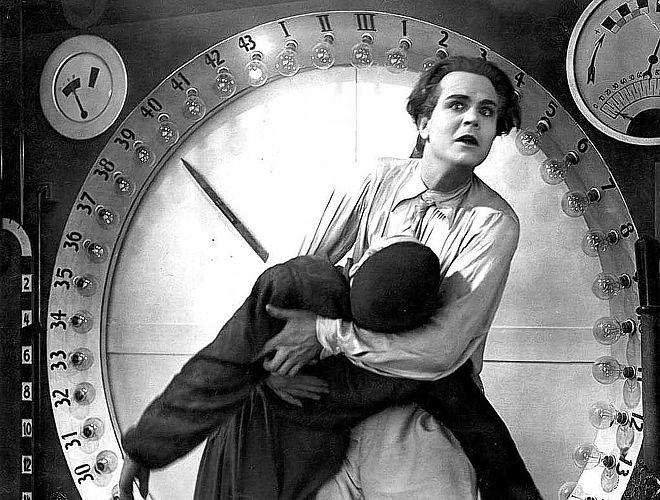
The emotionally overpowering realization that his vapid, sham life lives on the backs of such people, throws Freder into a hallucinatory fever. But such emergencies, where the work days are counted by a clock with 10 hours instead of 12, are common and accounted for. The machines are momentarily turned off, the dead and injured are taken away, more workers are woke and brought down to replace them, everything goes back online, and to the world above, the horror below was a moment's inconvenience.
Soon Freder is in his father's spacious office. Forced to patiently wait for his father to finish some business first, Freder tells of what he saw. A dawning knowledge has entered Freder's head. He is beginning to realize that his happiness comes at the horrific, mortal cost of other people's abject misery.
Coldly enraged by his son's revelation and judgement, Joh Fredersen casts an angry stare toward his majordomo, Josaphat (Theodor Loos: HOMUNCULUS [1-5], M, THE TESTAMENT OF DR. MABUSE). Josaphat bows his head in obsequious fear. Freder mimics Josaphat, as if they are both children being reprimanded by their father.
Then the Foreman of the machines is given an audience with Joh. With a mere motion of Joh's hand, Freder is made to wait again while business takes precedence.
The Foreman discovered more papers, in the pockets of the injured and dead: Papers with strange drawings on them like a map.
The angrier Joh becomes, the icier he gets. Without looking at him, Joh demands of Josaphat, why wasn't it he who knew of these papers and brought them first. Unmoved by Josaphat's apologies, Joh tells the man to collect his final paycheck.
Freder was always aware of his Father's power, and understands what it means to be fired by him. Taken aback by having witnessed his father's indifference to others, Freder runs out of the office and catches up with Josaphat, stopping him from certain suicide.
Joh is no fool. Expecting betrayal from his son's newfound knowledge, he sets a sinister spy (Fritz Rasp: TORMENTS OF THE NIGHT, BY ROCKET TO THE MOON, THE SORCEROR, THE TERRIBLE PEOPLE, THE PUZZLE OF THE RED ORCHID) on Freder.
Freder promises to hire Josaphat if he'll help him. Freder wants to know what the world is really like.
TRIVIA Recovered 1927 Metropolis Film Program Goes Behind the Scenes of a Sci-Fi Masterpiece Now, a remarkable 32-page theater program from Metropolis' 1927 debut has surfaced at a well-known rare book shop in London, which scanned it and shared some pages with Wired. Continued at Wired. Fritz Lang's Monster: Was Metropolis a Pro-Nazi Film The tragic and self-destructive life of Walter Schulze-Mittendorf. The man who created the Maschinenmensch (Machine Man) Maria for METROPOLIS. |
From this moment on, Freder's life takes a nose dive. Having no idea where his actions will lead or the harm and repercussions they will cause, but on fire with the righteousness of his new ideal, Freder voluntarily replaces Georgi (Erin Biswanger), a worker - 11811 - at one of the many stations of the Heart machine. He gives him Josaphat's address, some money, and makes plans to meet him later after the shift.
The worker doesn't understand, but accepts the money and revels at the newfound freedom of one day off. At first, Freder attempts to deal with the labor as per his sunny, optimistic nature. But soon the hot, oppressively exhaustive work bears down on him.
During the shift, another worker comes up, casts a furtive glance around, and reminds Freder - who he mistakes for a fellow co-worker - that Maria has called a meeting in the caverns. Freder has no idea what he is talking about, and can't take time from his machine to find out. By the end of the ten hour shift, Freder looks no different than the rest of the bone weary men, trudging from their machines.
Meanwhile, Joh goes to the oldest house in Metropolis. Here he meets his former friend and rival for the love of Hel, Rotwang (Rudolf Klein-Rogge: THE CABINET OF DR. CALIGARI, DR. MABUSE: THE GAMBLER, THE LAST WILL OF DR. MABUSE, THE TESTAMENT OF DR. MABUSE). Years ago in a love triangle, Hel left Rotwang for Joh. Then she died while giving birth to Joh's son. Rotwang has never forgiven his old former friend, nor has he ever lost his love for Hel. The city of Metropolis is also Rotwang's brainchild. Joh nd his vision funded it, but it was Rotwang who invented and created it. So a tenuous truce exists between the two men, as both possess what the other wants: Rotwang's genius, Joh's money.
Joh came for business, but Rotwang, delighted as any Science Geek would be, insists that Joh's all-important personal business wait. Only Rotwang can dare speak to Joh like this, and only Rotwang can make a frustrated Joh, grudgingly obey.
Rotwang has invented a new machine. A thinking, self-aware robot (Brigitte Helm) in the shape of a person. This is a prototype, but when he is finished, his robot will actually look like a human being. Imagine the possibilities!
Dutifully impressed, but not enough to please Rotwang, Joh then shows the scientist the papers his Foreman gave him. Rotwang recognizes them for what they are, a map leading to the depths of the forgotten caverns.
Of course, it is down in those caverns where the secret worker's meeting takes place and Freder sees the poor woman again and learns that her name is Maria (Brigitte Helm: QUEEN OF ATLANTIS). Maria tells the workers that their savior, the promised one, will come. They will be rescued from their slave labors by the chosen one who will bring together the minds of the creators with the hands of the workers. This chosen one, will be the mediator: the heart.
Above in a separate cavern and hidden from sight, Rotwang and Joh watch the meeting. In the crowd of worker uniforms, Joh doesn't recognize his own son among them. Seeing the potential for revolution, Joh decides to crush it early by having Rotwang give his robot Maria's face. With the robot Maria leading the worker's uprising, it will end in disaster, destroy the revolution, and increase Joh's power over them. Only now does Joh truly realize the "possibilities" of Rotwang's creation.
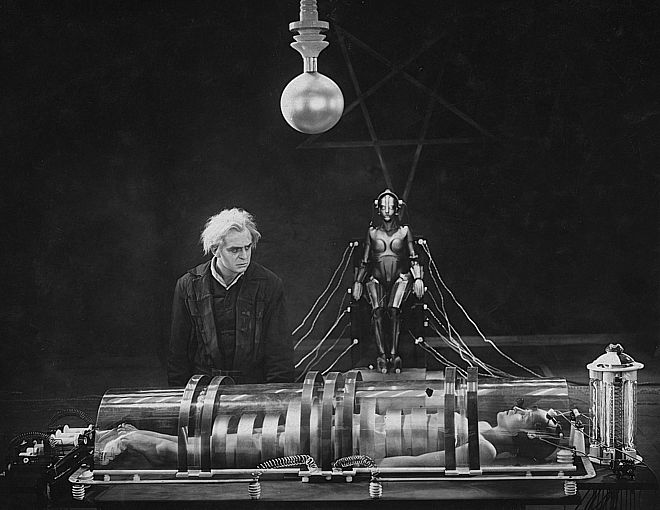
In METROPOLIS, as written by Thea Von Harbou and Directed by Fritz Lang (M), the complexity of human interaction abounds. Old truces collapse, new alliances and loyalties are created, betrayal is everywhere, and in a dawning age where robots can look and act like people, no one is what they seem.
Incredibly, some of the special effects by Ernst Kuntsmann: (THE TESTAMENT OF DR. MABUSE, HEXEN) still stand today, though nearly a century old, in black and white and silent. Some of the effects in fact, like the Schüfftan process, are still used today.
The problem with silent pictures is that everyone in them overacts to communicate the emotions they cannot speak.
Film as a medium was new, close-ups and extreme close-ups were experimental and a concept being taught to audiences. Most actors were stage trained to use their whole bodies in order to throw a silent emotion all the way to the very back of the theater. Subtlety was virtually non-existent - which makes many of the most necessary moments in the movie laughable to modern audiences as our cinematic experience recognizes hammy acting. Yet back in 1927, this was the best they could do. Every silent movie was blocked and staged as if beneath the arch of the proscenium.
Still, the story and Harbou's vision stand even now. It wouldn't take more than cosmetic changes to METROPOLIS, largely updating the technology, to make it applicable today and for an audience of the near future.
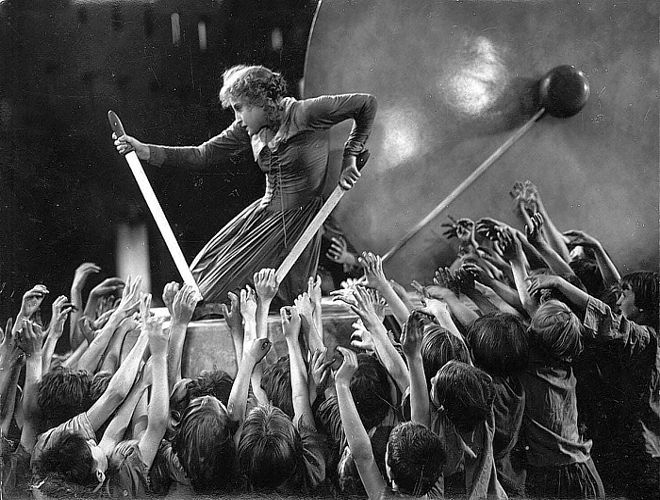
The city scape imagined by Lang and his Art Director Otto Hunt, remains futuristic and ignites the imagination.
If you see METROPOLIS for the first time, you will recognize so much that started with this movie. METROPOLIS inspired many, but is imitated by none.
Made a human lifetime ago, METROPOLIS reveals where we came from and where we are going.
Four Shriek Girls.

This review copyright 2011 E.C.McMullen Jr.

|
| GET COVERED | |
| YOU MIGHT ALSO ENJOY (Sub-Section: MALEVOLENT MACHINES) |
||
 |
 |
 |
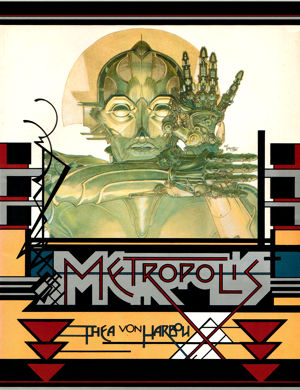
| METROPOLIS BOOK REVIEW |
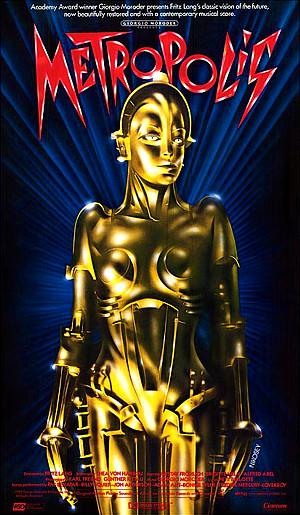
METROPOLIS: Goergio Moroder Edit MOVIE REVIEW |
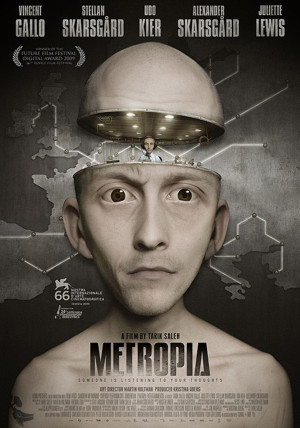
METROPIA MOVIE REVIEW |
FEO AMANTE'S HORROR THRILLERCreated by:E.C.McMullen Jr. FOLLOW ME @ |
| Amazon |
| ECMJr |
| Feo Blog |
| IMDb |
| Stage32 |
| YouTube |
| Zazzle Shop |