|
|
RICHARD MATHESON |
| RICHARD MATHESON | HARRY SHANNON | REVIEWS | FANBOY | MOVIES | CONVENTIONS |
|
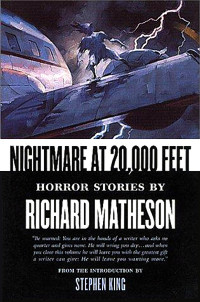
Okay, who the hell doesn't remember that Twilight Zone? William Shatner is still a handsome spring chicken, pounding on the window in coach, screaming that there is a gnarled little gremlin on the wing of the airplane? And we get the crawling awareness that he's freaking right, that there IS something out there? You don't remember that? Okay, so picture John Lithgow in living color, shrieking and sweating and carrying on while the musical score pounds like a horrified pulse and that icky green THING out there keeps messing with the engine on the left wing of the 747? Yeah. Now you remember. I first met Richard Matheson in 1983, while collaborating on a stage musical version of his novel "Bid Time Return" (better known as the sentimental "Somewhere In Time"). We worked together on and off for a few years on that project, which never came to fruition; Rich doing the book while I wrote lyrics. We became friends. In fact, Richard's wife Ruth introduced my spouse Wendy and I back in 1989; Wendy has known the Matheson family since childhood. Sadly, in the last twenty years I have watched Rich evolve from "well, actually, I don't really write horror any more" to a true ambivalence about having been one of the seminal giants in the field. It is his genuine, ever-deepening spiritual convictions that prevent him from revisiting the horror genre. And that's our loss. NIGHTMARE AT 20,000 FEET contains stories that go all the way back to the 1950's and now defunct magazines like "Imagination," "Startling Stories" and "Fantasy And Science Fiction," as well as "Playboy." The prose style is an education in itself: lean, mean and downright relentless. Despite having known Rich for some time, I had not read any of these pieces since I was in my teens and twenties. I grew up watching television shows he created; like "Duel," "Trilogy of Terror" and "The Night Stalker." And I really loved these stories. I devoured them all in one sitting. Know why? They still work. DAMN do they work. "Wet Straw" from Weird Tales (in 1953) is nothing short of brilliant. When seen in the context of its times, it is like comparing Mozart to his pallid competition. "The Distributor," an eerily bland recounting of a man doing evil work in a suburban neighborhood, feels anachronistic in some ways; yet remains decidedly upsetting nearly forty-five years after it was first created. These are not lurid, overwrought psuedo-Lovecraftian pieces which feel Victorian and stylized. This is not pulp writing at its finest, ala Robert Bloch. These are AMERICAN horror tales, and after devouring a few you will understand clearly why Stephen King cheerfully wrote the introduction to this volume. In it, he calls Matheson's appearance on the horror scene in the 1950's "a bolt of pure ozone lightning." In point of fact, King makes no secret of being hugely indebted to Richard Matheson, and he damn well shouldn't… because it's so obvious. Interested in writing? Get a copy of this book. Find a quiet place to read, dim the lights. Then picture the world these images first invaded: Imagine "Happy Days," milkshakes and juke boxes; "American Graffiti" and Vincent Price and Christopher Lee and cheesy SciFi/horror pictures in black-and-white and living innocently in the shadow of the bomb… Ready? Okay. Now open this book. You'll be dazzled by a mind that changed American fiction forever and led to the work of King, Thomas Harris, Dean Koontz, Peter Straub, Robert McCammon and anyone else who pretends to the throne. See if you don't agree with me. Richard Matheson? He's the Boss. We're not worthy. Believe it. 5 BookWyrms
This review copyright 2009 E.C.McMullen Jr. |
|
||||||||||||||||||||||||||||||||||
| Feo Amante's Horror Home Page, Feo Amante's Horror Thriller, and feoamante.com are owned and copyright 1997 - 2013 by E.C.McMullen Jr. FAIR USE - PRIVACY POLICY - OWNERSHIP - CONTACT All images and text belong to E.C.McMullen Jr. unless otherwise noted. All fiction stories belong to their individual authors. |
 |