 |
 |
Review by E.C. McMullen Jr. |
||||
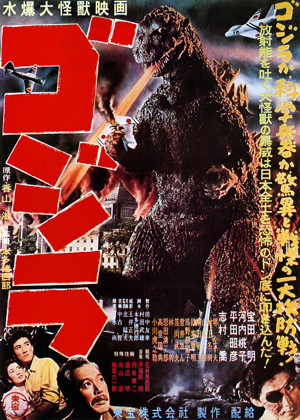
Japan Release: Nov. 3, 1954 USA Release: May 7, 2004 Toho Rated: NR |
||||||
SCIENCE FICTION DOUBLE FEATURE
Let me start off this review with a caveat. This caveat is to say that I'm fully aware that the original GOJIRA hasn't aged well. To today's audiences, even the original GOJIRA merely looks like some guy in a rubber suit. What's more, I'll even agree with you that the plot line, in several areas, stretches to breaking at many points. I'll grant you that.
But you'll have to accept the ranking I gave this movie for all of the reasons I explain. If you can deal with that from my point of view, then please read on and I'll share with you just why I love this damn movie.
Also, if you don't have a decent set of speakers, you'll want to have a good headset on for the embedded videos, beginning with...
Rialto Pictures 2004 and 2014 Re-Release
Theater sound was full blast stereo and high fidelity. The audience excitement? There is nothing hyperbolic enough to explain the mad cheering by the end of this trailer.
I was in a snooty arthouse theater and the audience went nuts!
I've never experienced anything like it before or since.
First, put yourself in the place of an audience today. Except for grievous examples of poor computer animated graphics, like the re-worked Star Wars "Jabba the Hut", or the ILM end-boss in DEEP RISING, or the bug-eyed monkey thing in Lost In Space, or any number of other awful examples: audiences really like computer animated graphics. They love them in THE MATRIX and they love them in THE LORD OF THE RINGS. But the truth is, we are giving the movie makers slack because we want to enjoy the movie as a whole.
TRIVIA This film was originally released in 1954. The heavily edited version was released to American audiences in 1956. The Official website of GODZILLA |
We love the story like the first JURASSIC PARK, so we accept the limitations of the medium. At least it ain't some guy in a rubber suit!
Now put yourself in the theater seats of a 1954 Japanese audience, and two years later in the seats of an American audience.
On the radio you've heard the ads for this new movie GOJIRA and the ads are punctuated by one hell of an alien roar!
You watch the movie, becoming absorbed in the story even though you feel that you will have to be forgiving - when the monster makes its appearance - the herky-jerky stop-motion animation effects that have dominated the medium for the last forty years. Stop Motion effects became a little smoother in that time, and the new Dynamation by Ray Harryhausen makes the actors seem to look right at, and interact (amazingly!) with the special effects monsters. But when the theater lights come up, it was still a stilted, not very real looking, monster.
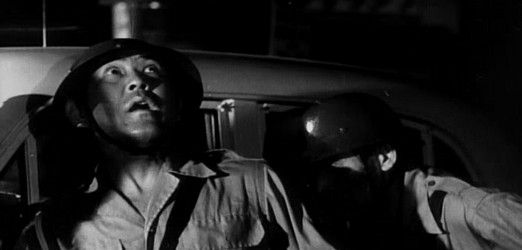
Even among the extras the acting was great. This guy is on screen for all
of two seconds, but he really SELLS the panicked terror of witnessing
GODZILLA.
(It's the director in a cameo)
When Godzilla finally makes his appearance at the end of the movie, however, you ain't thinking "man in a rubber suit". Such a thing has yet to exist. The movie teases you with shadows and distant glimpses. Finally, near the end of the movie, you hear those infamous footsteps (duplicated in Steven Spielberg's JURASSIC PARK). The speakers with their sound from the 1950s glissades with their drivers being strained. The theater seems to shake. The people on-screen can only wait in fearful disbelief. In the storyline, they've heard of the monster, but nobody, especially in modern 1950s Tokyo, can really believe that such a giant creature could exist.
Then Godzilla surfaces from the water. NO stop motion animated puppet can surface through water! What the hell is this? How did they do this? The city looks real! The buildings look real; every brick, every pipe! They have glass windows and lights inside and you see people in those windows! Godzilla walks through smoke and it curls around his body!
You've never seen anything like this before!
Your jaded eyes from the 1950s can pick out the puppet strings, the rotoscoping, layering, and rear projection sfx (like all of those black and white movies that show the actors in a car while the scene through the rear window goes turning this way and that - regardless of how the driver handles the steering wheel).
Original Trailer
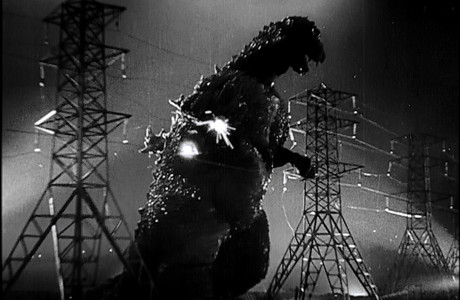
You are dumbfounded as Godzilla tears through high tension wires that crackle and spit with electricity. The wires smoothly strain, give, and snap under Godzilla's force. Godzilla's mighty tail sweeps through heavy tanks, sending their pieces, dirt and debris, flying toward the audience. Godzilla doesn't merely walk toward Tokyo like a rear projection, he walks through, interacts with the damn buildings by smashing them into a million pieces of rubble and dust. Impossible with stop motion animation! Through it all, the camera is always somewhere below the head of Godzilla. He towers over the camera and so he towers over us!
No 8 inch stop motion puppet ever towered over the camera!
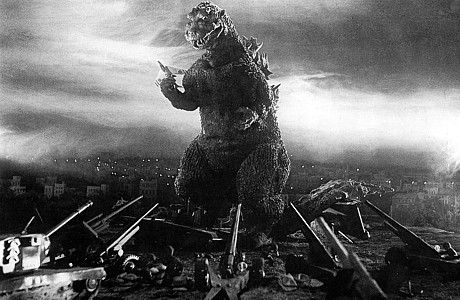
And then he roars!
He roars with a sound no Foley man had ever dreamt of prior to Godzilla. How can the much revered KING KONG hold a candle to this? King Kong and his travelling fur (due to the animator's finger pressure as they repositioned the doll for every frame) cannot hope to compare!
HOLY CRAP but this movie is stunning!
Have you ever read how, when early movie audiences were first shown a black and white movie of a train rushing toward them, at the last second most of them screamed and bolted from their seats? Prior to seeing it for the first time, the only thing people knew about a train coming toward them was "Get the hell out of the way!" There was simply nothing in human experience to prepare folks for an oncoming train - even in silent black and white - to rush right up and not harm you.
Once in a great while, a movie can break through that mental wall of the audience and grab them in the pit of their stomach. JAWS made many people afraid to go into the ocean or even large bodies of water. It was a phenomenon so remarkable that the tagline for the sequel actually said, "Just when you thought it was safe to go back into the water."
When GOJIRA roared and towered over 1954 audiences, they cringed back in their seats. GOJIRA moved and bellowed and looked around smoothly, ORGANICALLY. Director Ishirô Honda (JÛ JIN YUKI OTOKO, KAIJÛ O GOJIRA, SORA NO DAIKAIJÛ RADON, CHIKYU BOEIGUN, MOSURA, MATANGO, and lots more) shot the movie in 4:3 format to resemble the factual newsreels that theater audiences were accustomed to seeing and believing.
But you can believe in the
!!!SCIENCE MOMENT!!!:
The weapon that could destroy Gojira is Dr. Serizawa's Oxygen Destroyer. A weapon of mass destruction so fearsome that Serizawa is afraid to use it because world leaders, once they have knowledge of this weapon, would use it against people.
But just how bad can an Oxygen Destroyer be?
Beware of the Spoilers should you continue to SCIENCE MOMENT/Gojira.
Original 1954 GOJIRA Trailer
Originally released in 1954, GOJIRA was the brainchild of producer Tomoyuki Tanaka, who originally envisioned GOJIRA as a fire-breathing version of KING KONG. Lucky for him, he had writer Shigeru Kayama who wrote the short story as a 50 meter tall lizard. After the success of GOJIRA (roughly pronounced in Japanese as Go-jeeza), Shigeru wrote the novel of the same name, which was used as the basis for the 1955 movie GOJIRA NO GYAKUSHU or GODZILLA RAIDS AGAIN (GIGANTIS in the USA). The audiences wanted more and Shigeru wrote the 1956 novel, KAIJÛ O GOJIRA (GODZILLA! KING OF THE MONSTERS) which was quickly made into a movie released the following year. By this time, Shigeru was getting tired of writing about Godzilla so he wrote, CHIKYU BOEIGUN (THE MYSTERIANS or PHANTOM 7000) in 1957, which was a giant monster movie plus alien invaders but no Godzilla.
When GODZILLA was released in the U.S. and the rest of the world in 1956, much of the anti-atomic bomb storyline was removed and lots of exposition and narration from then bit actor Raymond Burr was inserted. The effort was dippy but the monster made up for it. For many adults it became a guilty pleasure and years later, for kids like me in front of a TV set on a Saturday afternoon, it rocked our world.
The American release took the name of Shigeru's novel, which was really the sequel to the original GODZILLA. The unapologetic, post WWII politics of the original GOJIRA guaranteed that U.S. audiences would not see the original GODZILLA play on their soil for the next 50 years.
* TRIVIA This news was kept secret from U.S. citizens for fear of causing a panic. Even decades later when it was finally released, the American Media agreed to bury the news in the U.S. Since Japan doesn't have a free press, it hasn't made the news at all there to this day. JAPANESE NUCLEAR WEAPONS PROGRAM Japan Tested Atomic Bomb in NK Before End of WWII? |
Quite by accident, and bumbling around the Internet, I came across this Quicktime trailer (RialtoPictures). GODZILLA was coming to my town! Well, actually, the film was coming to a town several towns away, but no matter: I was going to see the original, uncut, undubbed, GOJIRA!
What amazed me was how much better the original story stood up. I don't labor under the false pretense of "The original is naturally better" or the "Americanized/American remake sucks by default". But in this case, it truly did. Once you see the original GOJIRA, the Raymond Burr one will slough off of your radar.
The most important thing is, unlike the 1956 Americanized version, the Japanese characters are not so quick to leap to the conclusion that they are dealing with a giant lizard.
Near the end of the movie, few who have seen Godzilla have lived to tell the tale. Those that have are presumed to be suffering from hysteria (which, of course, they would be), or shock, or exposure or just about anything is a far better explanation than a giant lizard that in no way could possibly exist. Even by the standards set in the original GOJIRA movie, the very idea of such a massive creature in existence is ridiculous to the characters in the story. So when GOJIRA finally makes his appearance, the Japanese of modern Tokyo are struck dumb with horror and disbelief. There is simply nothing in their world experience to possibly prepare them for Godzilla.
Godzilla is the impossible, the ultimate fear of the unknown, come to life.
For today's audience, even for fans of the franchise, the original GOJIRA is a man in a rubber suit and the fun is in watching him tear a toy city apart. But see it now, and allow yourself to get into the story. Disbelieve, along with the characters, what the superstitious villagers and illiterate sailors are saying. Believe that there is some rational explanation for the disasters at sea; the reports coming from distant Japanese isles. The movie, at times, seems preachy in its anti-atomic bomb rhetoric, but be forgiving after all because, as of this writing, Japan is the only country who has ever suffered an atomic war.*
In other words, dive right into the movie.
As you ignored the shortcomings of the computer animated dinosaurs in JURASSIC PARK, ignore one more time the man behind the curtain. Feel the chill. Hear the roar!
GOJIRRAA!!!!!
5 Shriek Girls

This review copyright 2004 E.C.McMullen Jr.
How does GOJIRA (1954) stack up against the Reshot, ReCut version, GODZILLA: KING OF THE MONSTERS?
 Page 2 THE SECOND FEATURE

|
| SHRIEK GIRL | |


| YOU MIGHT ALSO ENJOY (Sub-Section: KOO-KOO FOR KAIJU) |
||
 |
 |
 |
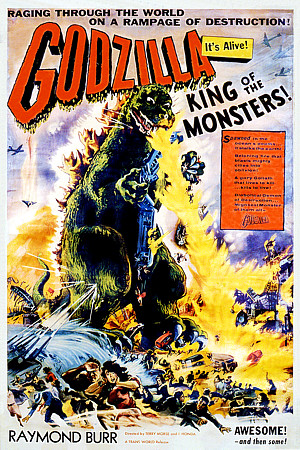
| GODZILLA: KING OF THE MONSTERS - 1956 MOVIE REVIEW |
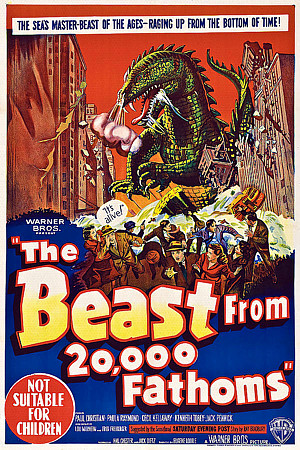
THE BEAST FROM 20,000 FATHOMS MOVIE REVIEW |
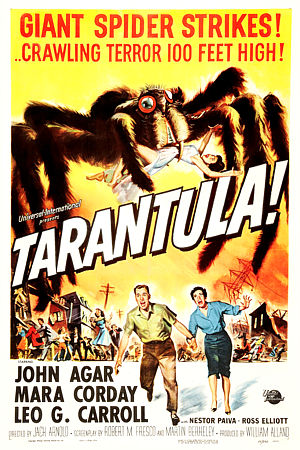
TARANTULA! MOVIE REVIEW |
For those who scroll...
GOJIRA was not inspired by the atom bombs dropped on the cities of Hiroshima and Nagasaki (15 kilotons of explosive energy), but by a horrific event that occurred nearly ten years later in 1954.
The Daigo Fukuryū Maru or Lucky Dragon Incident that took place March 1, 1954. That was the year when a thermonuclear bomb test expected to release approx. 5 Megatons of energy, released 250% to 300% more than theoretically calculated. Why the 50% discrepancy? It was so unexpectedly huge that the explosion went off the charts.
Yet the 11 ton bomb itself was considered so small it was nicknamed "Shrimp".
It was meant to be a small test in the most remote place in the massive Pacific Ocean. Relatively "Small" because the test was meant to be secret.
It turned out to be about 1,000 times more powerful than the bombs dropped on Hiroshima and Nagasaki.
To put its unexpected destruction into perspective: That's more explosive destruction than ALL the bombs dropped in World War II.
If the dot at the end of this sentence was the Shrimp, it could obliterate an area the size of Manhattan Island from the face of the earth, leaving nothing of the city and its life but a hole about 15 miles wide in diameter and over 25 feet deep.
This test was the infamous Castle Bravo.
| FEO AMANTE'S HORROR THRILLER Created by: E.C.MULLEN JR. |
| COME FOLLOW ME @ Amazon |
| ECMJr |
| Feo Blog |
| IMDb |
| Stage32 |
| YouTube |
| Zazzle Shop |