 |
 |
Review by E.C. McMullen Jr. |
|
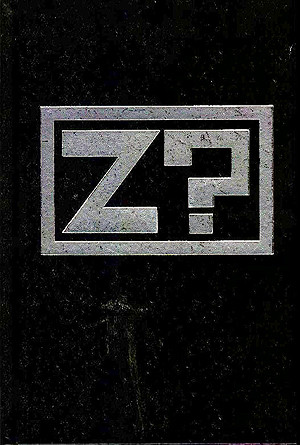
Writer/Artist: Jhonen Vasquez Slave Labor Graphics TPB and HC |
|||
"Some of this blood is mine."
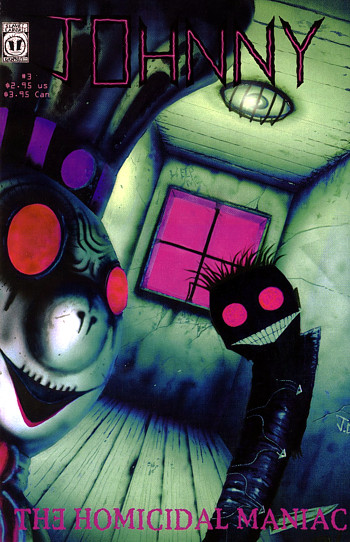
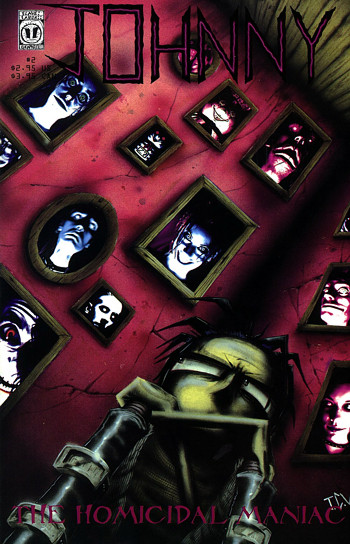
In the late nineteen nineties, When Linux had as much chance as making it as BeOS; before Windows 98; back when Steve Jobs still had people working at Apple who were willing to swallow their pride, make excuses for his wretched, selfish behavior and create the operating system that he would take the credit for; a cheap comic book with slick lurid colored covers and black and white newsprint pages came out from a new, fledgling company called Slave Labor Graphics.
The comic was called JOHNNY THE HOMICIDAL MANIAC (JTHM) and was both written and drawn by one Jhonen Vasquez. Who was he? Who knew? So away to your 33k modems, link to the Internet, and come away with nothing. There was very little, outside of a few meager fansites, on Jhonen Vasquez. Even those fansites didn't know much about him and at least one was sorely vexed at this situation - not that they didn't post his copyrighted artwork anyway.
No, all we had to go on was his work, and what work it was. If there was such a thing as shading, Vasquez wanted no part of it, until the very last page where he wrapped up all torment that had gone one before with a kind of Springer-ish "Jerry's Final Thought" (Oh HOW I wait for Jerry's FINAL THOUGHT). The whole book was done in only the very stark contrast of very black ink on a very white page. Can you picture it? Good. Now picture this: artwork done with the tip of a razor sharp nib scrawled - and I mean scrawled! - like it was cut into the page.
 The comic started with a frightened little
boy who hears noises in his house. He goes to his parents for comfort,
but they are too wrapped up in themselves and their own problems to care at all for his.
The comic started with a frightened little
boy who hears noises in his house. He goes to his parents for comfort,
but they are too wrapped up in themselves and their own problems to care at all for his.
Facing his fears alone, he comes across the giant, hulking, and electrified shrieking presence of Johnny ("but you can call me NNY..."). When Johnny asks the little boy's name, he can only let out a constricted, frightened "Squee" sound - which NNY mistakes for his name.
Johnny casually tells the boy that he broke into his bedroom because he needs Bactine ("Some of this blood is mine."). The person that he just murdered scratched him up good and NNY doesn't want his wounds to get infected.
While in the child's company, Johnny reels between seeming kind and being the mentally deranged dangerous psychotic he is. Johnny parts company with Squee on a rather unsettling note, and because the child is our sympathetic character guide, and thus us, we are hooked.
The next tale has to do with a person going door to door. The neighborhood is being traumatized by a horribly vicious killer and this person wants to know how the neighborhood folks feel about it. If the first one questioned is any indication, people living in this neighborhood, whose very lives are being affected by the killer, are too wrapped up n their daily teevee shows to give the problem much thought. And so the killer, their neighbor, continues on his private rampage unaffected.
It is in this second story that Jhonen Vasquez attempts to absolve himself of any and all responsibility for his writing - and it's a tired ploy that I've seen before from many writers - Robert Crumb being the first that comes to mind.
At one point, the interrogator asks NNY, "So what do you think of the idea that violence on television and other media may have a negative effect on kids and other impressionable minds?"
Before I give NNY's answer, let's drop the phony "I didn't do it" crap and admit that teevee and all other forms of media are all forms of communication. We communicate our thoughts, emotions, ideas, and beliefs by voice audible or written - Obviously. No contract is more binding than one that is written. We attach a strong credibility to the statement "There it is in black and white."
Therefore...
This continues on into fiction.
There is fiction we love, like, and could care less about, and some literature / fiction that we despise. Whether you are talking about William Shakespeare, Mary Shelly, Mark Twain, H.P. Lovecraft, Ogden Nash, Ayn Rand, or Marilyn Manson, you are talking about people who commited their thoughts, ideas, and beliefs into the fictional, printed word - or recorded sound - to communicate those thoughts to the world and enrich or alter their beliefs. The reason that Jhonen Vasquez wrote JOHNNY THE HOMICIDAL MANIAC (as well as both modeled and named the character after himself) was to communicate his anger, ideas, and beliefs through his cartoon doppleganger. This comic is not just so much pointless drivel. So when NNY's response to the question of "...violence in the media having a negative effect on kids..." is,
"Any pile of stunted growth unaware that entertainment is just that and nothing more deserves to doom themselves to some dank cell, somewhere, for having been so stupid!! Movies, books, T.V., music - they're all just entertainment, not guidebooks for damning yourself!"
The message rings loud and clear and false. There is too much thought, philosophy, and intriguing points of view in JOHNNY THE HOMICIDAL MANIAC, for us to read it then toss it aside, next to the GQ magazine, as mere entertainment.
So don't try and bullshit me with that smirking "Its just entertainment!" shoulder shrug crap! Or cop-out with Crumb's air-head cheerleader sprightly, "It's just ink on paper!" And when you are talking about something that can affect children, don't give me that "pile of stunted growth" garbage either. Just stop pissing on about having to label your work as being "for adults" and just say, "Hey! This ain't for kids!" What's so freaking hard about that?
 Now then -
Johnny is a Homicidal maniac. He slaughters people when their insensitivity or stupidity (or both and sometimes innocent bystanders) derail the peacefulness of his life.
This is never a sure thing because Johnny's thoughts are far from peaceful.
Johnny kills people who are a pain in his ass. But Johnny also kills to feed one of the walls of his house with blood. He paints the wall with blood and it is always drying. He must keep it wet, so he is always killing.
His best friend is a dead rabbit (another of his victims) and his two worst enemies are the bickering Styrofoam characters that look vaguely familiar to a certain animated advertising character for bread products.
He also draws cartoon Noodle Boy, who is a homeless character that mindlessly walks down the streets, uncomprehending of the real world that exists around him, and shouts obscenities to all.
As the story progresses, the character develops and Johnny, while trying to get better (he tries to understand his actions and what led him to this state) also gets worse. Full of self-doubt, he spirals down a dark well of questioning his questions until all his logic and reason eventually falls apart. Even then, he goes on.
When finding what he needs, acceptance, he tries to destroy it. Finding admiration for who he is, he is repulsed, for he hates himself.
This is a brilliant story of someone desperately trying to fight against their own insanity: trying to make themselves whole even while falling apart.
Johnny cannot be forgiven and Jhonen doesn't ask that of his audience. Johnny, too full of self-loathing to accept love or admiration, cannot hope to be cured by anything other than his own death, yet even attempts at suicide are thwarted by circumstance, making him wonder, in his most maniacal moments, if he is even capable of being killed or caught. He is so full of self-hatred, yet trapped by his own life to perpetuate the thing he hates most (himself) that he even wonders aloud how a God can allow people like him to even exist.
Jhonen Vasquez wants to be taken seriously. That's not to say that JTHM is all serious. It wouldn't work if it was. It also wouldn't work if Jhonen had drawn his characters in a more realistic manner.
JTHM is incredibly violent, but presented in such a cartoonish format, its also enormously funny. At the same time the laughs are coming, so is the creepy fear. You feel as if you really shouldn't be laughing at such monstrosity, but you do. As a well adjusted adult you can appreciate the absurdity and admit to yourself that, as a human being, you've more than once wanted to slaughter some asshole who was just begging to be put out of his or her misery.
JTHM makes you laugh at the fools that clutter our lives, but also makes you laugh at yourself for getting so worked up over such inconsequential people. NNY overreacts on a scale that puts him both above and far beneath the people who are the subjects of his rage.
Johnny is never a good guy, some of his victims are innocent. And there are times when Johnny teeters on the edge of being saved from himself, only to lose whatever hope there could be by his own twisted sense of purpose. Johnny is hilarious in his extremism and insanity, but he is also a cartoon.
* Nothing against Todd McFarlane though. I've met him at the autograph booths of Comic conventions and the guy really appreciates the trouble and time it takes for people who like his stuff to drive, park, and pay to meet him. He takes his time with the fans. ^ |
In this Graphic novel, we get to see Johnny's growth at a rather accelerated rate. Jhonen wasn't worried about five hundred and fifty fucking flavors of plastic Spawn outfits*, so he didn't try and drag NNY out through ten+ years of aimless wandering, self-pity, and angst. He told his story and moved on.
First he moved on to the child SQUEE (Todd) and the boy's wretched life. There was some fun there and far less senseless murder. Aliens took the place of homicidal maniacs and, though people still got what they deserved, they lived to tell about it, and perhaps learn from it. Jhonen had taken NNY as far as he could go... for the moment.
After SQUEE, it was just too bad he moved on to Nickelodeon and Space Invader Zim. A bunch of spastic cartoons shouting at each other nonstop is only funny if something funny is happening. Shouting, by itself, is not funny.
Like the best DVDs, JHTM graphic novel has a nice load of extras (this book is even called, The Director's Cut): Johnny's origins as a small child bullying the other children in his school. There is an interview (of sorts) and more.
Talk about degrees of separation, Johnny made his original appearance in the Goth magazine, Carpe Noctem, when my bud and feoamante.com alumni, Mikey Huyck was fiction editor. Life is weird.
But if you are a fan of dark or morbid humor (think Gahan Wilson's work or Edward Gorey's THE GASHLYCRUMB TINIES) you will probably love JOHNNY THE HOMICIDAL MANIAC. Even more so because, unlike Gorey, whose tiny tales of butchered children were meant to be poetic and clever, JHTM is also meant to be thought provoking even while you laugh.
All in all and despite Jhonen's protests to the contrary, this entertainment of his has something meaningful to say and it says it in an outrageous, disturbing way. JTHM was and is a groundbreaking story and comic.
JOHNNY THE HOMICIDAL MANIAC graphic novel gets all five FanBoys.
Review copyright
2002 by E.C.McMullen Jr.
| WEAR ONE OF MINE | |
JUXT SUPPOSE |
To be sure, there were/are other maniac comics out there with homicidal types as the main character / anti-hero: Some that came before JTHM. But they coughed and sputtered or just sank from their own bullshit. The one that immediately comes to mind (because of the hue and cry I've heard over JTHM being some kind of rip-off of it) is Diane DiMassa's HOTHEAD PAISAN: Homicidal Lesbian Terrorist. Apparently Hothead is a lesbian not because she enjoys the sexual company of women, but because men in the Western world are so unforgivably vile (it's okay to be gay, Diane. You don't need an excuse). Unlike Johnny, Hothead feels self-pity not for the life she chose, but for the life she has been "forced to live". NNY is meant to be an extreme yet unreasonably rational sympathetic character, while being an out of control murderous maniac. Hothead is undisguised bigotry and sexism and always goes after males, and the men always deserve it for no other reason but that they're not female. After Paisan tortures, slaughters and mutilates men by the thousands, she then weeps dramatically over the death of two of her lesbian sisters who were shot in the head, thus justifying her own actions (arm across her eyes for dramatic gravitas - yet this is meant to be a serious moment). At the end of the graphic novel, Hothead's mercy and forgiveness comes in the form of a benediction from a spirit who shares her crazed world view. In interviews, DiMassa explains that Hothead is not really sick, the world is sick: It's not her fault, it's everyone else's fault: Hers is an extreme but logical point of view. And so terrorism is justified. Then again, in such a world, since I'm the target of such rage my thoughts and feelings on the subject have no value or credibility (gathered from reading articles written by women who love the comic book). You could say by that logic, women's thoughts on the repulsive Japanese comic book, Rapeman, are invalid. One of the saving graces of HOTHEAD PAISAN was Diane herself, who may have influenced Jhonen by doing the sideline, linear notes, pointing out her mistakes, self-effacing humor, and so on. Then again they may have both got this from Robert Crumb or Sergio Aragones. Then again they may all have grown up with Harvey Kurtzman and his little cartoons running between the panels of Mad Magazine and through the lettering of the word "MAD" in the old covers. Who knows? At any rate, I've never read or heard of Diane directly making sour remarks about Jhonen, only the fans. Fans can be rabid. JOHNNY THE HOMICIDAL MANIAC takes full responsibility for its actions, places them clearly at the feet of its protagonist, and neither plays favorites (except in the case of not intentionally harming children or painting Johnny as a rapist) or begs for absolution. The humor is often self-referential and self-effacing. Take it in fun, take it serious, but have the strength of character to be responsible for your own decisions. |
| FEO AMANTE'S HORROR THRILLER Created by: E.C.MULLEN JR. |
| COME FOLLOW ME @ Amazon |
| ECMJr |
| Feo Blog |
| IMDb |
| Stage32 |
| YouTube |
| Zazzle Shop |